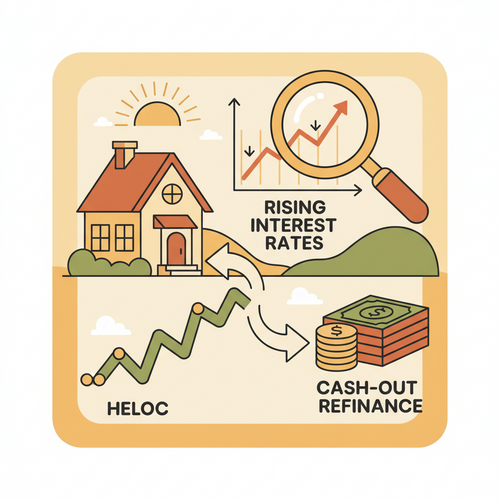
Navigating the complex world of home equity borrowing, especially when considering a HELOC vs Cash-Out Refinance in a high-rate market, demands careful consideration. Homeowners often seek to leverage their property’s value for various financial needs, whether it’s consolidating debt, funding home improvements, or covering unexpected expenses. However, the current economic climate, characterized by elevated interest rates, significantly influences the attractiveness and suitability of each option. Understanding the nuances between a Home Equity Line of Credit (HELOC) and a cash-out refinance becomes paramount for making a financially sound decision. This article will thoroughly explore both avenues, helping you discern the best path forward for your specific situation.
Understanding Home Equity: Your Financial Lever
Home equity represents a significant asset for many individuals. It’s essentially the portion of your home that you truly own outright, free and clear of any mortgage obligations. This valuable asset can serve as a powerful financial tool, offering liquidity when needed. Moreover, understanding how to strategically tap into this equity is crucial for informed financial planning.
What is Home Equity?
Your home equity is calculated by subtracting your outstanding mortgage balance from your home’s current market value. For instance, if your home is appraised at $500,000 and your remaining mortgage is $200,000, your equity stands at $300,000. This equity grows over time, primarily through two mechanisms: paying down your mortgage principal and an increase in your property’s market value. Consequently, a substantial amount of equity can provide a robust financial cushion and opportunities for strategic borrowing.
The Impact of High Interest Rates on Home Equity Borrowing
High interest rates profoundly affect borrowing against home equity. When rates are elevated, the cost of borrowing increases, making both HELOCs and cash-out refinances more expensive. Therefore, borrowers must carefully evaluate the total cost of each option, including interest payments over the life of the loan. Furthermore, high rates can also influence market demand for homes, potentially affecting property values and, in turn, your available equity. Astute planning and a clear understanding of market dynamics are essential.
HELOC: Flexibility with Variable Rates
A Home Equity Line of Credit (HELOC) offers homeowners a revolving line of credit, much like a credit card, but secured by their home’s equity. This flexibility can be highly appealing for those with ongoing or uncertain financial needs. However, the variable interest rate associated with most HELOCs introduces a layer of complexity, particularly in a high-rate market.
How a HELOC Works
With a HELOC, lenders typically approve you for a maximum borrowing amount based on a percentage of your home’s equity, often up to 80% or 90% of its appraised value, minus your existing mortgage. You can draw funds as needed, up to that limit, during a specific “draw period,” which usually lasts 5 to 10 years. During this period, you often only pay interest on the amount you’ve borrowed. Once the draw period ends, the “repayment period” begins, requiring you to pay both principal and interest, often over 10 to 20 years. This two-phase structure provides significant flexibility in managing your funds. Additionally, as you repay the principal, the available credit line replenishes, allowing you to borrow again.
Advantages of a HELOC in a High-Rate Environment
One primary advantage of a HELOC is its unparalleled flexibility. You only pay interest on the amount you actually borrow, not the entire approved line of credit. This can be cost-effective for projects with staggered expenses, like a multi-phase home renovation. Moreover, the interest-only payment option during the draw period can keep initial monthly payments lower, providing breathing room. In a high-rate environment, if rates are expected to decline in the future, a variable rate could eventually work in your favor, leading to lower payments later on. This adaptability is a key differentiator between a HELOC vs Cash-Out Refinance.
Disadvantages and Risks of a HELOC
The most significant drawback of a HELOC, especially in a high-rate market, is its variable interest rate. Your payments can increase significantly if rates rise, making budgeting challenging and potentially straining your finances. Furthermore, the interest-only payments during the draw period mean you’re not reducing your principal balance, which could lead to a “payment shock” when the repayment period begins. Also, because your home secures the HELOC, defaulting on payments could lead to foreclosure. Therefore, careful risk assessment is paramount before committing to a HELOC.
Cash-Out Refinance: Fixed Rates and New Terms
A cash-out refinance involves replacing your existing mortgage with a new, larger mortgage. The difference between the new loan amount and your old loan balance, after closing costs, is paid to you in cash. This option typically offers a fixed interest rate, providing predictability, which is a major draw for many homeowners. Consequently, it’s a popular choice for those seeking a lump sum of money.
How a Cash-Out Refinance Works
When you opt for a cash-out refinance, you essentially refinance your original mortgage for a higher amount than you currently owe. The difference is then given to you as a lump sum of cash. This means you’ll have a new mortgage with new terms, including a potentially new interest rate and repayment schedule. Lenders typically allow you to borrow up to 80% of your home’s appraised value, just as with a HELOC. The funds from a cash-out refinance can be used for any purpose, from significant investments to debt consolidation. This makes it a versatile tool for accessing your home equity.
Advantages of a Cash-Out Refinance
The primary advantage of a cash-out refinance, particularly in a high-rate environment, is the security of a fixed interest rate. This provides predictable monthly payments for the life of the loan, making budgeting straightforward and eliminating the risk of payment increases due to rising rates. Moreover, a cash-out refinance often comes with a longer repayment term, which can result in lower monthly payments compared to a HELOC, even if the interest rate is higher. Many homeowners also appreciate receiving a single, large sum of cash, which simplifies funding large projects or paying off substantial debts. This certainty is a strong point when comparing a HELOC vs Cash-Out Refinance.
Disadvantages and Considerations
Despite its benefits, a cash-out refinance has several significant drawbacks. Firstly, it entails paying closing costs, which can range from 2% to 5% of the new loan amount, adding substantially to the overall expense. Secondly, you are effectively restarting your mortgage term, potentially extending your repayment period and the total interest paid over the long run. If current interest rates are significantly higher than your existing mortgage rate, a cash-out refinance could lead to a much higher overall borrowing cost. This makes it less appealing if your current mortgage rate is very low. Furthermore, you increase your primary mortgage debt, which could elevate your risk if property values decline or your financial situation changes.
Side-by-Side Comparison: HELOC vs. Cash-Out Refinance
Deciding between a HELOC and a cash-out refinance requires a thorough comparison of their core features. Both allow you to tap into your home equity, but they differ significantly in their structure, cost implications, and suitability for various financial goals. Therefore, a clear understanding of these differences is essential for making an informed choice in today’s financial landscape.
Interest Rates and Payment Structures
A crucial distinction lies in their interest rates. HELOCs almost always feature variable rates, meaning your monthly payments can fluctuate. This introduces an element of unpredictability, which can be a significant concern during periods of rising interest rates. Conversely, cash-out refinances typically offer fixed rates, ensuring your principal and interest payments remain constant throughout the loan term. This predictability is a major advantage for budgeting and long-term financial planning. Regarding payment structures, HELOCs have a draw period (often interest-only) followed by a repayment period (principal and interest). Cash-out refinances, however, involve immediate principal and interest payments on the entire new loan amount.
Fees, Closing Costs, and Speed
Another significant point of comparison involves the associated costs and processing time. Cash-out refinances typically involve substantial closing costs, similar to a traditional mortgage refinance, including appraisal fees, origination fees, and title insurance. These can amount to thousands of dollars. HELOCs, conversely, often have lower or even no upfront closing costs, though some lenders might charge an annual fee or a small origination fee. Furthermore, a HELOC can often be approved and funded more quickly than a cash-out refinance, which involves a more extensive underwriting process. Therefore, if speed and lower upfront costs are priorities, a HELOC might be more appealing, despite its variable rate.
Best Use Cases for Each Option
The ideal choice between a HELOC vs Cash-Out Refinance largely depends on your specific financial needs and goals. A HELOC is generally better suited for ongoing or unpredictable expenses, such as extensive home renovations with phased payments, funding college tuition over several semesters, or creating an emergency fund that you hope not to tap into frequently. Its flexibility allows you to borrow only what you need, when you need it. On the other hand, a cash-out refinance is typically ideal for a large, one-time expenditure, such as consolidating high-interest debt into a lower, fixed-rate mortgage, paying for a major medical expense, or making a significant investment. It provides a lump sum with predictable payments, offering financial stability.
Making Your Decision: Key Factors to Consider
Choosing between a HELOC and a cash-out refinance is a personal financial decision that should align with your broader monetary strategy. No single option is universally superior; rather, the best choice depends on a confluence of individual circumstances, financial objectives, and market outlook. Therefore, a thorough self-assessment is essential before proceeding.
Your Financial Goals
Firstly, clearly define your financial goals. Are you looking for a flexible funding source for a multi-year project, or do you need a substantial lump sum for a specific, immediate expense? If your goal is debt consolidation with a fixed repayment schedule, a cash-out refinance might be more appropriate. However, if you anticipate needing access to funds intermittently over time, a HELOC offers that unparalleled flexibility. Consider also how long you plan to stay in your home, as this affects the long-term cost implications of restarting a mortgage with a refinance. For a deeper understanding of debt consolidation strategies, Investopedia offers comprehensive insights.
Risk Tolerance and Market Outlook
Your personal risk tolerance plays a pivotal role in this decision. Are you comfortable with the uncertainty of a variable interest rate that can fluctuate with market conditions? Or do you prefer the stability and predictability of a fixed-rate loan, even if it comes with higher upfront costs? In a high-rate market, a HELOC’s variable rate poses a greater risk of increasing payments, while a cash-out refinance locks in the current higher rate. Moreover, consider the broader economic outlook. If interest rates are expected to rise further, a fixed-rate option might be more appealing. Conversely, if rates are predicted to fall, a variable-rate HELOC could become more attractive over time. Staying informed about economic trends from reliable sources like Reuters Finance can be beneficial.
Consulting with a Financial Advisor
Finally, it is highly advisable to consult with a qualified financial advisor. A professional can help you analyze your specific financial situation, assess your risk tolerance, and project the long-term costs and benefits of both a HELOC and a cash-out refinance. They can provide personalized advice tailored to your goals and help you navigate the complexities of interest rates, closing costs, and repayment structures. Their expertise is invaluable, especially when dealing with such significant financial decisions. Understanding your options through a professional lens ensures you make the most informed choice for your future. For more information on finding a reliable advisor, resources from reputable government agencies can be helpful, such as those found on USA.gov’s financial help section.
Conclusion
The choice between a HELOC and a cash-out refinance is a critical financial decision, particularly in a high-rate market. Both options offer distinct advantages and disadvantages, catering to different financial needs and risk appetites. A HELOC provides flexibility with a revolving line of credit and variable rates, making it suitable for ongoing, uncertain expenses. Conversely, a cash-out refinance offers a lump sum with the stability of a fixed interest rate, ideal for large, one-time expenditures and debt consolidation. Ultimately, understanding your financial goals, evaluating your risk tolerance, and seeking expert advice are crucial steps. By carefully weighing the pros and cons of a HELOC vs Cash-Out Refinance, homeowners can make an informed decision that optimally leverages their home equity to achieve their financial aspirations, even when interest rates are high.