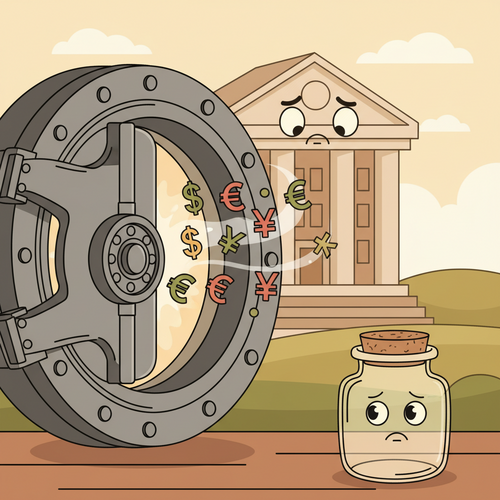
- 📉 Negative interest rates mean banks pay to hold reserves, pushing lending rates below zero for some.
- 💡 Central banks use them to stimulate borrowing and spending, fighting deflation in a weak economy.
- 🏦 For you, it could mean reduced savings returns, cheaper loans, and a shift in investment strategies.
Ever heard of banks paying *you* to borrow money, or charging *you* to keep your savings? It sounds like something from a financial fantasy novel, right? Yet, negative interest rates are a very real economic tool that central banks in several countries have already experimented with.
The idea can seem upside down at first glance. Traditionally, banks pay you interest for your deposits, and you pay them interest for loans. But what happens when the numbers flip? We’re going to break down this complex topic into clear, actionable insights, focusing on what it means for your money.
Understanding Negative Interest Rates: Could It Happen Here?
What Exactly Are Negative Interest Rates?
Imagine your bank charging you a small fee just to hold your cash. That’s essentially the core concept of a negative interest rate. Instead of earning interest, your money subtly diminishes over time. This applies primarily to commercial banks depositing their reserves at the central bank.
When the central bank sets its policy rate below zero, it means commercial banks have to pay for the privilege of parking their excess funds there. This cost can then ripple through the entire financial system. Ultimately, this pressure can lead banks to charge individuals and businesses for holding large deposits or, conversely, offer loans with extremely low (or even technically negative) rates.
Why Would Central Banks Go Negative?
Central banks aren’t trying to make your life harder; they’re trying to inject life into a stagnant economy. The primary goal is to stimulate borrowing and spending. When holding cash becomes costly, banks are incentivized to lend it out, and people and businesses are encouraged to invest and spend rather than save.
Another key reason is to combat deflation, a dangerous economic state where prices fall, making consumers delay purchases and businesses cut back. Negative rates aim to push inflation up to healthy levels. They also aim to weaken the domestic currency, making exports cheaper and boosting international trade.
Pro Tip: Don’t confuse negative interest rates with inflation. While both can erode purchasing power, negative rates are a *policy tool*, whereas inflation is a broader economic phenomenon. Always keep an eye on your real (inflation-adjusted) returns.
How Do Negative Rates Affect Your Wallet?
For savers, the impact is often direct and unpleasant. Your traditional savings accounts might offer zero or even slightly negative returns. This means the purchasing power of your money held in a bank could slowly erode, especially when factoring in inflation.
On the flip side, borrowers could see significant advantages. Mortgage rates and other loan products could become incredibly cheap. In some countries, borrowers have even received payments from banks due to deeply negative rates on certain loans, though this is rare for typical consumer loans.
Your investment landscape also shifts. Bond yields, which often move with interest rates, would likely fall even further, making fixed-income investments less attractive. This could push investors towards riskier assets like stocks or real estate.
Real-World Examples: Where Has This Happened?
Negative interest rates aren’t just theoretical. Several central banks around the globe have implemented them. The European Central Bank (ECB), the Bank of Japan, and the central banks of Switzerland, Denmark, and Sweden are prime examples.
Their experiences have been mixed. While some argue it helped avoid deeper recessions and boosted inflation slightly, others point to challenges for banks’ profitability and the difficulty for savers. It’s a complex economic experiment with ongoing debates.
- 🇪🇺 European Central Bank: First introduced negative rates in 2014, impacting Eurozone countries.
- 🇯🇵 Bank of Japan: Adopted negative rates in 2016 to fight persistent deflation.
- 🇨🇭 Swiss National Bank: Has maintained some of the deepest negative rates globally.
- 🇸🇪 Sweden’s Riksbank: Was one of the first, eventually exiting negative territory.
- 🇩🇰 Danmarks Nationalbank: Used negative rates to defend its currency peg to the Euro.
Could Negative Interest Rates Happen in the US?
The Federal Reserve, the US central bank, has historically resisted the idea of negative interest rates. Fed officials have often expressed skepticism about their effectiveness and potential side effects. They prefer other tools like quantitative easing to stimulate the economy.
However, during severe economic downturns, all options can be on the table. While unlikely as a first resort, a prolonged and deep recession, coupled with zero-bound conventional rates, *could* theoretically push the Fed to consider it. It would represent a significant and controversial policy shift for the US.
In my experience, financial markets often price in possibilities long before they become reality. Paying attention to central bank speeches and economic indicators is crucial. Don’t wait for headlines to react; understand the underlying trends.
Comparing Economic Scenarios: Positive vs. Negative Rates
| Feature | Traditional (Positive) Rates | Negative Rates |
|---|---|---|
| Savers | Earn interest, money grows. | May pay fees, money erodes. |
| Borrowers | Pay interest on loans. | Cheaper loans, potentially very low/zero cost. |
| Banks | Earn profit from lending margin. | Pressured margins, may charge deposit fees. |
| Economic Goal | Normal growth, price stability. | Stimulate spending, fight deflation/recession. |
| Currency Impact | Generally strengthens currency. | Tends to weaken currency. |
How to Potentially Navigate a Negative Rate Environment
Even if negative rates seem far-fetched in the US, understanding how to adapt is always smart. Your financial strategy should be agile and responsive to changing economic conditions. Here are a few things to consider.
First, holding excessive amounts of cash in a traditional savings account might become less appealing. Consider diversifying where you store your liquid funds. This doesn’t mean taking on undue risk, but exploring options that offer better returns or protection against erosion.
Warning: Don’t panic and make impulsive decisions. Any shift to negative rates would be widely telegraphed. Always consult a trusted financial advisor before making major changes to your portfolio. Think long-term, not short-term reactions.
Secondly, look at your debt. If rates are extremely low, it might be a prime opportunity to refinance mortgages or consolidate high-interest debt. Making your debt cheaper can free up significant cash flow.
Actionable Insight: Refinancing your home loan or other debts could provide substantial savings during periods of ultra-low or negative rates. Compare fixed-rate vs. adjustable-rate options carefully.
Third, consider investments that typically perform well in low-rate environments, or those that offer income streams independent of interest rates. Dividend-paying stocks, certain real estate investments, or even inflation-protected securities could become more attractive. However, always remember that investments carry risk.
Finally, stay educated. The financial world is constantly evolving, and new challenges require new understanding. Reliable sources like Bloomberg, The Wall Street Journal, or The Financial Times can keep you informed. Knowledge is truly power in managing your money effectively.
- 💰 Review Savings: Are your current accounts offering competitive rates, even if low?
- 💳 Evaluate Debt: Could refinancing existing loans save you money?
- 📈 Diversify Portfolio: Look beyond traditional bonds for income and growth.
- 📚 Stay Informed: Follow economic news and central bank policies closely.
- 🤝 Seek Advice: A financial advisor can offer personalized guidance.
Conclusion
Negative interest rates remain a powerful, albeit controversial, tool in the central banker’s arsenal. While not currently in play in the US, understanding their mechanics and potential impacts is crucial for any financially savvy individual. The global economy is interconnected, and lessons from abroad can certainly inform our future here.
The key takeaway is preparedness and flexibility. Don’t let economic jargon intimidate you from taking control of your financial future. What steps will you take to protect your finances and adapt to a changing monetary landscape?