Introduction
Imagine you are enjoying a delicious meal in a charming Parisian bistro. The waiter brings the bill, and you are asked a seemingly convenient question: “Would you like to pay in Euros or your home currency, US Dollars?” Many travelers, seeking familiarity, instinctively choose their home currency. This seemingly innocuous choice, however, activates a common financial pitfall known as Dynamic Currency Conversion (DCC). It is a subtle trap that can quietly inflate your travel costs, often without you even realizing it.
Understanding and avoiding DCC is crucial for anyone who travels internationally. This article will demystify Dynamic Currency Conversion, expose its hidden costs, and provide you with actionable strategies to safeguard your finances while exploring the world. Mastering this aspect of travel finance will save you money and enhance your peace of mind.
What is Dynamic Currency Conversion (DCC)?
Dynamic Currency Conversion (DCC) is a service offered by merchants, typically at the point of sale (POS) terminal or ATM, that allows you to pay for goods or services in your home currency, even when you are abroad. On the surface, this might appear convenient. It provides an an immediate calculation of the cost in a familiar currency, removing the need for mental arithmetic or currency converter apps.
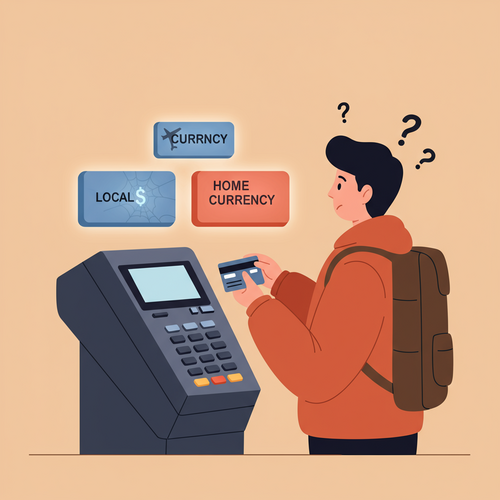
Here is how it typically works: When you present your credit or debit card for payment in a foreign country, the merchant’s payment terminal detects that your card is issued in a different currency. The system then offers you the option to complete the transaction in either the local currency (e.g., Euros in France) or your home currency (e.g., US Dollars if your card is from the US).
The critical point to grasp is that when you choose your home currency via DCC, the exchange rate is determined by the merchant’s bank or a third-party DCC provider, not your own card issuer (Visa, Mastercard, etc.). This distinction is paramount, as it is the root of the financial trap. Your card is then charged in your home currency, appearing as a domestic transaction on your statement, although it originated internationally.
Many travelers fall for this because it offers perceived transparency. Seeing the exact amount in their familiar currency feels reassuring. However, this comfort comes at a significant premium.
The Hidden Costs: Why DCC is a Trap
The “convenience” of Dynamic Currency Conversion comes with a steep price. When you opt for DCC, you effectively hand over the currency exchange process to a third party, and they rarely offer rates that favor you. Here are the primary reasons why DCC is a financial trap:
Unfavorable Exchange Rates
- When you choose DCC, the exchange rate applied is almost always significantly worse than the wholesale interbank rate that your own card issuer (like Visa or Mastercard) would use.
- Your bank or card network typically offers a near-market exchange rate, often with a small, transparent markup. DCC providers, however, apply their own, much less competitive rates, resulting in a higher cost for you.
- This difference might seem small on a single transaction, but it adds up quickly over multiple purchases during your trip.
Additional Service Fees and Markups
- Beyond the poor exchange rate, DCC providers and merchants often embed an additional service fee or markup into the transaction. This can range from 3% to 7% or even higher.
- This fee is often hidden within the unfavorable exchange rate, making it difficult to discern how much extra you are actually paying.
- Essentially, you are paying for the “privilege” of seeing the charge in your home currency, a service that provides no real benefit and costs you more.
Potential for Double Conversion Fees
- Some credit card companies charge a foreign transaction fee for purchases made outside your home country, typically ranging from 1% to 3% of the transaction amount.
- While DCC aims to make the transaction appear domestic, some card issuers still identify the original country of the merchant. In such cases, they might still levy their own foreign transaction fee, even after the DCC provider has already applied their markup.
- This results in a “double-dip” of fees, drastically increasing your total expense for the transaction. Always check your card’s terms and conditions regarding international purchases.
Lack of Transparency
- The exchange rates and fees used by DCC providers are frequently opaque. Merchants are not always required to clearly disclose the exact exchange rate being used or the margin being applied compared to the official interbank rate.
- This lack of clear information makes it nearly impossible for you to make an informed decision at the point of sale. You are essentially trusting the merchant or DCC provider to offer a fair deal, which is rarely the case.
Real-World Scenarios and Examples
Dynamic Currency Conversion can appear in various situations during international travel. Recognizing it is your first line of defense:
At Retail Shops and Restaurants
This is the most common encounter. When you pay for your souvenirs or dining, the POS terminal will often display two options: “Pay in Local Currency (e.g., EUR)” or “Pay in Your Home Currency (e.g., USD).” Always select the local currency. Merchants might sometimes try to pre-select your home currency or suggest it for your convenience. Be firm and choose the local option.
When Using ATMs Abroad
DCC is also prevalent at ATMs. After inserting your card and entering your PIN, the ATM screen might ask if you want to complete the withdrawal in the local currency or your home currency. Again, always choose the local currency. If you opt for your home currency, the ATM operator will apply their unfavorable exchange rate and potentially additional fees.
Online Shopping from Foreign Merchants
The DCC trap extends beyond physical locations to online international shopping. If you are purchasing something from an overseas website, watch out for options to pay in your home currency. While it might seem easier, you are likely incurring extra costs compared to letting your bank handle the conversion at its standard rate. Ensure the transaction is processed in the merchant’s local currency.
An Illustrative Example
Let’s consider a simple scenario. You are in Rome, Italy, and your bill for a lovely dinner is €100. The current interbank exchange rate is €1 = $1.08. Your credit card issuer would typically process this at around €1 = $1.085 (including a small, transparent markup), costing you approximately $108.50.
However, if you opt for DCC, the merchant’s provider might use an exchange rate of €1 = $1.15, and on top of that, add a 3% service fee. This would convert your €100 bill to $115, plus a 3% fee on $115 ($3.45), bringing your total to $118.45. In this single transaction, DCC cost you nearly $10 extra. Over an entire trip with multiple such transactions, these small surcharges accumulate rapidly.
How to Always Avoid DCC
Avoiding the Dynamic Currency Conversion trap is straightforward once you know what to look for. Vigilance and informed choices are your best defense:
1. Always Choose Local Currency
- This is the golden rule: When presented with the option to pay in local currency or your home currency, always select the local currency.
- On POS terminals, look for phrases like “Pay in [Local Currency]” or “Do not convert.”
- At ATMs, choose the option that refers to the local currency, often displayed as “Without conversion” or “Local currency.”
2. Be Vigilant and Assertive
- Merchants sometimes pre-select your home currency, hoping you won’t notice. Always review the screen or receipt before confirming a transaction.
- If a merchant asks you verbally, clearly state, “Please charge me in [local currency, e.g., Euros].”
- Do not be afraid to refuse a transaction if DCC is forced upon you. Politely ask the merchant to reprocess the payment in local currency.
3. Educate Yourself and Others
- Many travelers are unaware of DCC. Share this knowledge with friends and family planning international trips.
- Understanding how DCC works is the first step in avoiding it consistently.
4. Use the Right Travel Cards
- Before traveling, consider acquiring a credit card that specifically advertises no foreign transaction fees. Many travel-focused credit cards offer this benefit.
- Cards without foreign transaction fees ensure that even when you pay in local currency, you are not hit with an extra percentage by your own bank.
- Reputable financial institutions like Visa and Mastercard provide excellent exchange rates, which you benefit from when you decline DCC.
5. Understand Your Bank’s Policies
- Review your credit and debit card agreements before you travel. Understand what exchange rates your bank uses and what, if any, foreign transaction fees apply.
- Knowing this information empowers you to make the best decision at the point of sale.
Best Practices for International Spending
Beyond avoiding DCC, adopting a few smart financial habits can significantly improve your international travel experience and keep your budget in check:
Use Credit Cards with No Foreign Transaction Fees
- As mentioned, this is paramount. Many premium travel cards offer this perk. Make sure you understand the terms, including any annual fees, to decide if it is right for your travel habits.
- Using these cards for most of your purchases allows your bank or card network to handle the currency conversion at very favorable rates.
Carry Some Local Cash
- While cards are widely accepted, small vendors, markets, or public transport might be cash-only.
- Withdraw a moderate amount from an ATM upon arrival, always choosing to be charged in the local currency.
- Avoid carrying excessive amounts of cash for security reasons.
Notify Your Bank of Travel Plans
- Before you depart, inform your bank and credit card companies about your travel dates and destinations.
- This prevents them from flagging your international transactions as suspicious activity and potentially freezing your card.
Monitor Your Bank Statements Regularly
- Keep an eye on your online banking statements while traveling and upon your return.
- Immediately report any suspicious activity or charges that seem incorrect. This also helps catch any instances where DCC might have been applied without your explicit consent.
Consider Travel-Friendly Debit or Prepaid Cards
- Some debit cards (often from challenger banks or specific travel-oriented financial services) offer fee-free international ATM withdrawals and favorable exchange rates.
- Prepaid travel cards can be a good option for budgeting, allowing you to load money in advance and sometimes lock in exchange rates. Always check their fees and rates carefully.
Conclusion
Dynamic Currency Conversion is a persistent financial trap lurking in international travel. It preys on the desire for convenience and familiarity, silently draining your travel budget through unfavorable exchange rates and hidden fees. By understanding what DCC is and how to actively avoid it, you empower yourself to make smarter financial choices abroad.
Remember the golden rule: always opt to pay or withdraw cash in the local currency of the country you are visiting. Combine this vigilance with using credit cards that waive foreign transaction fees, carrying a sensible amount of local cash, and monitoring your expenditures. These proactive steps ensure that your hard-earned money goes towards memorable experiences, not unnecessary surcharges. Travel wisely, pay smart, and enjoy every moment of your international adventures without financial regret.