Introduction
You have likely seen the offers in your mailbox or online, presented in bold, enticing letters: “0% APR for 18 Months!” For anyone struggling with high-interest credit card debt, this can seem like a golden ticket—a chance to finally get ahead. A balance transfer credit card is one of the most powerful tools available for aggressively paying down debt. When used correctly, it can save you hundreds, or even thousands, of dollars in interest and shorten your path to becoming debt-free.
However, this powerful tool can also be a dangerous trap for the unprepared. The same features that make it so attractive can quickly turn against you if you don’t have a solid plan. It is not a magic solution, but rather a highly specialized financial instrument that requires strategy and discipline. This guide will serve as your strategic manual. We will break down exactly how a balance transfer works, the critical details in the fine print, and the step-by-step plan you need to use this tool to your advantage and avoid falling into a deeper financial hole.
What is a Balance Transfer and Why is 0% APR So Appealing?
A balance transfer is a straightforward concept: you open a new credit card that offers a promotional low—usually 0%—interest rate on transferred balances for a set period of time. You then move your existing debt from your old, high-interest credit cards onto this new card.
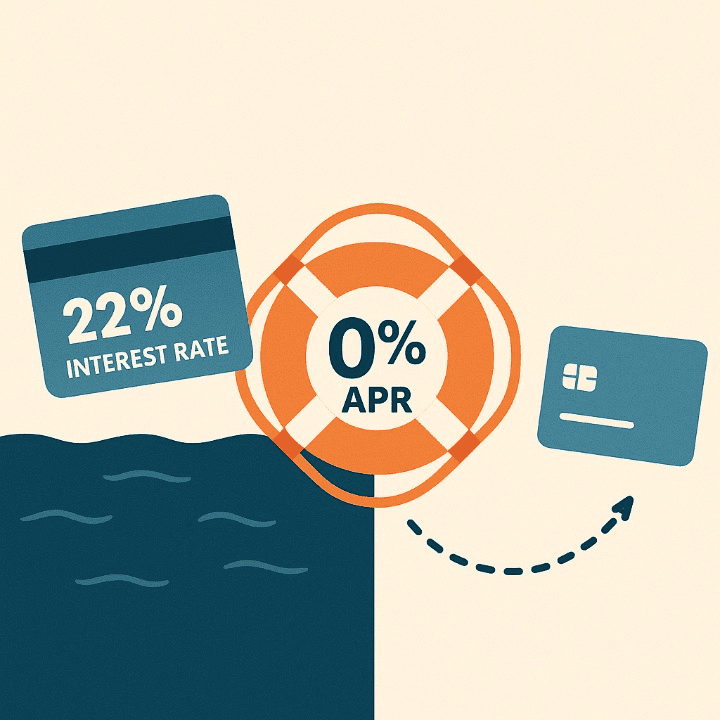
The power of this move lies in the math. Let’s say you have a $5,000 balance on a credit card with a 22% interest rate. Each month, a significant portion of your payment is consumed by interest charges alone, making it feel like you are running on a treadmill. When you move that $5,000 to a card with a 0% introductory rate, the dynamic changes completely. For the entire promotional period, every single dollar you pay goes directly toward reducing your principal balance. This allows you to make real, accelerated progress on paying off your debt. It’s like a temporary pause button on interest, giving you a crucial window of opportunity to get ahead.
The Fine Print: Critical Details to Understand Before You Apply
The success or failure of a balance transfer strategy often comes down to understanding the details that are buried in the terms and conditions. Before you even think about applying, you must be aware of these key factors.
The Balance Transfer Fee
The 0% interest is the main attraction, but the transfer itself is rarely free. Most cards charge a one-time balance transfer fee, which is typically 3% to 5% of the amount you are moving. For example, if you transfer a $5,000 balance, a 3% fee would add $150 to your new balance, making your starting debt $5,150. You must include this fee in your calculations to ensure the interest you save is still greater than the cost of the fee.
The Introductory Period
The 0% interest rate is not permanent. It lasts only for a specific promotional period, which could be anywhere from 12 to 21 months. You need to know this timeline exactly, as it will be the deadline for your debt payoff plan.
The “Go-To” Interest Rate
This is the single most important detail and the heart of the “trap.” After your introductory period ends, any remaining balance on the card will be subject to a much higher, variable interest rate. This “go-to” rate is often as high, or even higher, than the rate on your original card. If you haven’t paid off the balance in time, you could find yourself right back where you started, but with a new credit card.
The Impact on Your Credit
A balance transfer can have a mixed, but generally positive, impact on your credit score over time.
- Initial Dip: When you apply for the new card, the lender will perform a “hard inquiry” on your credit report, which can cause a small, temporary dip in your score. Opening a new account will also slightly lower the average age of your accounts.
- Potential Rise: The big benefit comes from credit utilization. By moving a large balance to a new card with a high limit and paying off your old cards, you drastically lower your overall utilization ratio. Since this is a major factor in your credit score, this can lead to a significant improvement over a few months.
The Strategic Plan: How to Execute a Balance Transfer Successfully
To make a balance transfer work for you, you cannot treat it casually. You need a clear, disciplined plan from day one.
- Step 1: Do the Math First. Before you apply, calculate your potential savings. Estimate the total interest you would pay on your old card over the promotional period and compare it to the one-time balance transfer fee. The savings should be significant to justify the move.
- Step 2: Create a Payoff Plan. This is the most crucial step. Take your total new balance (including the transfer fee) and divide it by the number of months in the promotional period. This is the minimum amount you must pay every single month to be debt-free before the 0% interest rate expires.
- Step 3: Stop Using the Old Cards. A balance transfer is not an excuse to create more debt. Once you have cleared the balances on your old cards, you must stop using them. The goal is to reduce your total debt, not just move it around and free up space to spend more.
- Step 4: Automate Your Payments. Set up an automatic monthly payment from your checking account for the amount you calculated in Step 2. This ensures you are always on time and consistently chipping away at the principal.
A Practical Scenario: How David Escaped High-Interest Debt
David had a $6,000 balance on a credit card with a high 24% interest rate. He was paying $200 per month, but was frustrated to see how much of it was being eaten by interest. His credit score was still good, so he did his research.
He was approved for a balance transfer credit card offering a 0% introductory interest rate for 18 months, with a 3% transfer fee.
- The Math: The transfer fee was $180 ($6,000 x 3%). His total new balance became $6,180.
- The Plan: To pay this off in time, David calculated that he needed to pay $344 per month ($6,180 / 18 months).
- The Action: David committed to the plan. He set up an automatic payment for $344 and put his old credit card in a drawer. While the monthly payment was higher than what he used to pay, he was motivated because he knew every dollar was going toward his actual debt.
At the end of the 18 months, David made his final payment and was completely free of that high-interest debt. He had successfully used the 0% window to save a substantial amount in interest charges.
Conclusion
A balance transfer credit card is a highly specialized financial tool. It is not a simple fix for debt, but rather a golden opportunity—a window of zero interest—that allows you to make significant progress. Its success or failure hinges entirely on your ability to be strategic, disciplined, and committed to a payoff plan. When you use it as a targeted weapon against a high interest rate, a balance transfer can be a financial game-changer. However, without a clear plan, the introductory offer can quickly become a dangerous trap that leads to even more debt. The power is in your hands to choose which outcome you will have.