Introduction
Albert Einstein is often credited with calling compound interest the “eighth wonder of the world,” adding that “he who understands it, earns it; he who doesn’t, pays it.” While the quote’s origin may be debatable, its message is one of the most profound truths in personal finance. Compound interest is a silent, relentless force that, over time, can either generate extraordinary wealth or create a mountain of overwhelming debt. It’s the secret behind how small, consistent investments grow into large fortunes, and at the same time, it’s how a minor credit card balance can spiral out of control. Understanding this double-edged principle is fundamental for anyone who wants to take control of their financial future. This guide will demystify the mechanics of compound interest, showing you how to wield its power for good and defend against its destructive effects.
What is Compound Interest? Beyond the Basics
To truly appreciate the power of compound interest, we first need to understand its simpler cousin: simple interest.
- Simple Interest: With simple interest, you earn interest only on the original principal amount. For example, if you invest $1,000 at a 5% simple interest rate, you will earn $50 in interest every single year. Each year, the calculation is based on the same original $1,000. It’s a linear and predictable growth.
- Compound Interest: This is where the magic happens. Compound interest is “interest on interest.” In the first year, the calculation is the same as simple interest. However, from the second year onward, you earn interest not only on the original principal but also on the accumulated interest from the previous periods.
The best analogy is a snowball. As you roll a small snowball from the top of a hill, it starts to pick up more snow. As it gets bigger, it picks up even more snow with each rotation, growing exponentially until it becomes an avalanche. Your investments work in the same way.
The Magic of Compounding: Your Greatest Wealth-Building Ally
When it comes to saving and investing, time is your most powerful ingredient. Compound interest massively rewards those who start early, even with small amounts. There are three key factors that drive this growth:
- Principal: The initial amount of money you invest.
- Interest Rate: The rate at which your money grows.
- Time: The length of the period during which your money can grow and compound.
Let’s illustrate the power of time with a classic example.
The Scenario: Consistent Chloe vs. Later Leo
Imagine two friends, Chloe and Leo. They both decide to invest for retirement in a fund that has an average annual return of 8%.
- Consistent Chloe begins investing $200 per month at age 25. She does this consistently for 40 years, until age 65.
- Later Leo thinks he has plenty of time and decides to wait. He starts investing the same $200 per month at age 35, doing so consistently for 30 years, until age 65.
Chloe only invested for 10 more years than Leo. Her total out-of-pocket investment was just $24,000 more ($200 x 12 months x 10 years). What do you think the difference will be in the end?
- At age 65, Leo will have accumulated approximately $272,000.
- At age 65, Chloe will have accumulated approximately $623,000.
That staggering difference of over $350,000 is not primarily due to the extra $24,000 Chloe invested. It is due to the extra 10 years her money had to compound. The interest she earned in her early years started earning its own interest, creating a snowball effect that Leo could never catch up to.
The Dark Side of Compounding: Your Most Formidable Foe
Unfortunately, this powerful force works with the same efficiency in the opposite direction. When you owe money, especially on high-interest debt, compound interest can be your worst enemy, working tirelessly to deepen your financial hole.
The Credit Card Trap
The clearest and most dangerous example of negative compounding is credit card debt. Most credit cards carry a very high annual percentage rate (APR), often upwards of 20%. Furthermore, they compound interest daily or monthly.
When you carry a balance on your credit card, the unpaid interest is added to your principal balance. The next month, you are charged interest on this new, larger balance. If you only make the minimum payment, it often barely covers the interest charge for the month, meaning the principal shrinks very slowly, if at all.
The Scenario: The $2,000 Purchase
Imagine someone makes a one-time, $2,000 purchase on a new laptop using a credit card with a 22% interest rate. If that person decides to only pay the minimum payment each month (usually a small percentage of the balance), the results are shocking:
- It would take them over 15 years to pay off the debt.
- The total amount paid would be nearly $5,000, meaning they paid almost $3,000 in interest alone.
The $2,000 laptop ends up costing the price of two. This is how compound interest turns small debts into major financial burdens.
How to Make Compound Interest Work for You (and Not Against You)
The beauty of compound interest is that it is a neutral force. You have the power to decide which side of that force you want to be on.
To Make it Work FOR You:
- Start Early: As the Chloe and Leo example shows, time is your greatest asset. Begin saving and investing as early as you possibly can, even if it’s a small amount.
- Be Consistent: Regular, consistent contributions unlock the power of compounding over time.
- Reinvest Your Earnings: Ensure that any dividends or interest you earn are reinvested so they, too, can start earning interest.
- Look for a Competitive Interest Rate: Whether in a high-yield savings account or in investments, a higher rate of return will supercharge the process.
To Stop it From Working AGAINST You:
- Pay Your Credit Card Balance in Full: The golden rule is to pay your credit card statement balance in full every month. By doing this, you pay zero interest, and the negative power of compounding never even begins.
- Prioritize High-Interest Debt: If you have existing debt, make paying down the balances with the highest interest rates your top priority.
Conclusion
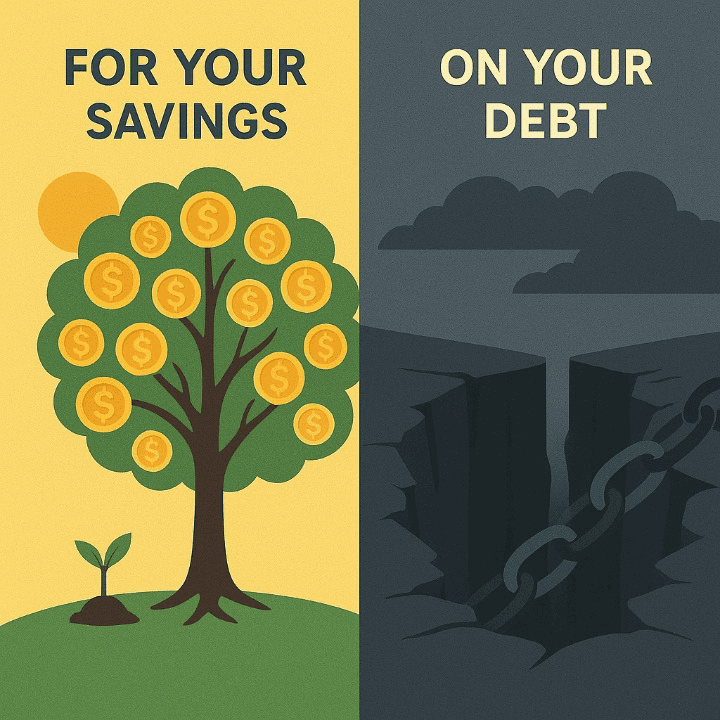
The double-edged sword is the perfect metaphor for compound interest. It is a neutral, mathematical force that amplifies whatever it is applied to. When applied to your savings and investments, it can build your wealth exponentially over time. When applied to high-interest debt, like that from a credit card, it can dig a financial hole that gets deeper and deeper.
The key to financial freedom is to deeply understand this principle. It means consistently putting the power of compounding to work in your favor by being patient and disciplined with your investments. It also means protecting yourself from its destructive side by aggressively managing any high-interest debt. The choice of which side of the sword you are on is yours, and the earlier you decide, the more powerful this force will become in your life.