Introduction
Have you ever thought about what would happen if an unexpected event turned your financial world upside down? A sudden medical emergency, an unforeseen car accident, or damage to your home can create immense stress, not just emotionally but financially. For many beginners and intermediate learners in personal finance, the path to stability can feel confusing. You might be focused on budgeting and saving, which are crucial, but what protects you from the major events that savings alone can’t cover? This is where a financial safety net becomes essential. A robust safety net provides peace of mind, allowing you to navigate life’s uncertainties without derailing your long-term goals. A central pillar of this protection is insurance, a concept often misunderstood but fundamental to sound financial planning. This guide will demystify how it works and explore its role in creating a secure foundation for your future.
What Exactly Is a Financial Safety Net?
A financial safety net is a combination of financial strategies and products designed to protect you from the financial shock of unexpected events. Think of it as having both a first-aid kit and a comprehensive health plan. The first-aid kit is for minor issues you can handle yourself, while the health plan is for serious situations requiring professional help.
In financial terms, your safety net has two primary components:
- An Emergency Fund: This is your “financial first-aid kit.” It’s a pool of liquid savings, typically 3 to 6 months’ worth of essential living expenses, stored in an easily accessible bank account. This fund is intended for smaller, more predictable emergencies, like a minor home repair or a temporary job loss. It gives you immediate access to cash without needing to take on debt or sell investments.
- A Comprehensive Insurance Portfolio: This is your “financial health plan.” While an emergency fund is for manageable setbacks, insurance is designed to protect you from catastrophic events that could otherwise lead to financial ruin. It’s a tool for transferring risk. You pay a predictable amount (a premium) to an insurance company, and in return, they agree to cover a much larger, unpredictable financial loss if a specified event occurs. This strategy is key to long-term financial protection.
The Core Role of Insurance in Your Financial Protection
Understanding insurance is less about complex financial products and more about a simple, powerful idea: shared risk. When you buy an insurance policy, you join a large group of people who are all contributing to a collective pot of money. Most people in the group won’t experience a major loss in any given year, but the funds are there to help the few who do.
Imagine you live in a community of 1,000 homeowners. There’s a small chance—say, 1 in 1,000—that any single home could be destroyed by a fire in a year, with a rebuilding cost of $300,000. It would be nearly impossible for one person to save that much for such a rare event. However, if every homeowner contributes $300 a year to a shared fund, that fund will have $300,000 available to help the one person whose house is unfortunately lost.
This is the essence of insurance. It transforms a potentially devastating, unpredictable cost into a manageable, fixed expense. It provides a predictable way to manage unpredictable risks, forming the backbone of your financial protection strategy and safeguarding your other financial assets.
Key Types of Insurance for Building Your Safety Net
Building a financial safety net with insurance involves selecting coverage that aligns with your life circumstances. While there are many specialized types of insurance, a solid foundation for most people includes a few key categories.
1. Health Insurance
This is arguably the most critical type of insurance for protecting both your health and your wealth. A single major medical procedure can cost tens or even hundreds of thousands of dollars. Health insurance helps cover these costs, including doctor visits, hospital stays, prescription drugs, and preventive care. Understanding terms like premiums (your regular payment to keep the policy active), deductibles (what you pay before insurance kicks in), and co-pays (a fixed amount for a service) is essential.
2. Auto Insurance
If you own a vehicle, auto insurance is not just a good idea—it’s often legally required. It protects you financially in case of an accident, theft, or other damage to your car. A basic policy typically includes liability coverage, which pays for damages you cause to others. More comprehensive policies can also cover repairs to your own vehicle, medical expenses for you and your passengers, and costs related to uninsured motorists.
3. Homeowner’s or Renter’s Insurance
Your home is likely your most significant asset, and renter’s insurance protects the value of your personal belongings. Homeowner’s insurance covers damage to the structure of your home and your possessions from events like fire, storms, or theft. It also provides liability coverage if someone is injured on your property. Renter’s insurance is similarly important for tenants, as a landlord’s policy does not cover your personal items.
4. Disability Insurance
One of your most valuable assets is your ability to earn an income. Disability insurance is designed to replace a portion of your income if you become sick or injured and are unable to work. Many people overlook this coverage, but without it, a long-term disability could severely impact your ability to pay for basic living expenses, let alone save for the future.
5. Life Insurance
If you have dependents—such as a spouse, children, or aging parents—who rely on your income, life insurance is a critical component of your financial safety net. In the event of your passing, it provides a tax-free lump sum to your beneficiaries. This money can be used to replace lost income, pay off debts like a mortgage, fund a child’s education, or simply cover final expenses.
A Practical Scenario: Meet Sarah
Let’s consider Sarah, a 30-year-old graphic designer who is building her financial knowledge. She has an emergency fund covering four months of expenses. One day, she is involved in a minor car accident that wasn’t her fault. The other driver is underinsured. Sarah injures her wrist and her car needs significant repairs.
- Without Insurance: Sarah would have to drain her entire emergency fund to cover her medical bills and car repairs. If the costs exceeded her savings, she might have to take on debt, potentially impacting her credit score and delaying her financial goals.
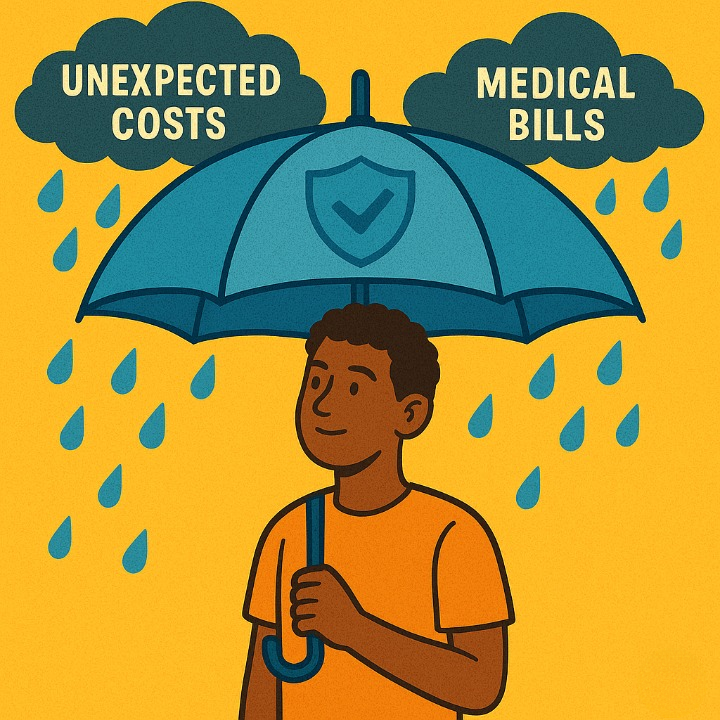
- With Insurance: Her health insurance covers the majority of her medical treatment costs after her deductible. Her auto insurance, which includes uninsured motorist coverage, pays for the car repairs. She only has to pay her deductibles, which she can comfortably cover with a small portion of her emergency fund. The rest of her savings and her long-term financial plan remain intact. Sarah’s story illustrates how having the right insurance provides a powerful shield, allowing her to recover physically and financially without a major setback.
Conclusion
Building a financial safety net is a foundational step in any personal finance journey. It’s about creating a structure that can withstand the inevitable storms of life. While an emergency fund provides crucial liquidity for smaller issues, a well-thought-out insurance portfolio is what protects you from the large-scale events that can threaten your financial well-being. Understanding the role of health, auto, disability, and life insurance is not about planning for the worst-case scenario out of fear; it’s about empowering yourself with the tools for resilience. By transforming large, unpredictable risks into manageable costs, you are not just buying a product—you are investing in long-term peace of mind and securing the future you are working so hard to build. Continue exploring what financial protection means for your unique journey.