Executive Summary
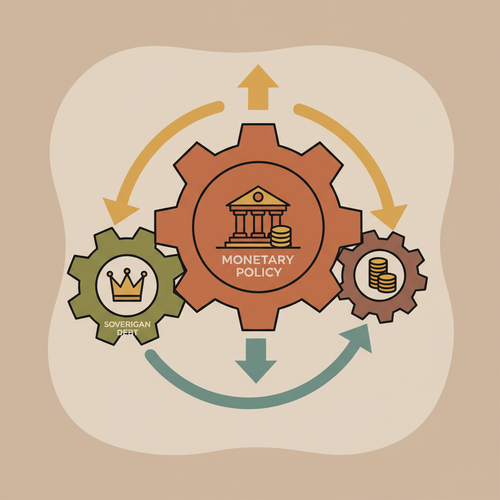
- Macroeconomic debt yield dynamics present complex challenges for institutional investors.
- Monetary compression phases demand sophisticated portfolio adjustments and risk frameworks.
- Navigating sovereign interest cycles requires acute awareness of systemic and geopolitical factors.
Unpacking Debt Yield Dynamics in a Constrained Environment
Debt yield dynamics fundamentally reflect the cost of capital. This cost is critical for governments and corporations alike. Central bank policies heavily influence these dynamics. Monetary compression actively shapes the yield environment.
Quantitative Tightening (QT) programs withdraw liquidity. This action directly impacts bond market supply-demand balances. Higher bond yields often result from these shifts. Market participants adjust their risk premiums accordingly.
Inflationary pressures also drive yield movements. Real yields adjust based on future inflation expectations. Investors demand adequate compensation for purchasing power erosion. This intricate dance defines the yield trajectory.
The Mechanics of Monetary Compression and Yield Curve Reconfiguration
Monetary compression, primarily QT, involves reducing central bank balance sheets. Central banks sell off government bonds or allow them to mature. This reduces demand for new issuance. Consequently, bond prices fall, and yields rise.
The yield curve graphically depicts this. Short-term yields are highly sensitive to policy rates. Long-term yields reflect growth and inflation expectations. Compression often flattens or inverts the curve.
A flattened curve signals economic slowdown concerns. An inversion historically precedes recessions. These signals are critical for economic forecasting. Understanding duration risk becomes paramount for bondholders.
Expert Insight: “Analyzing recent market shifts, duration risk has significantly increased. Investors holding long-term bonds face amplified price sensitivity to rate changes. This necessitates a proactive approach to portfolio immunization strategies.”
The term premium also reconfigures during these cycles. Investors typically demand more for holding longer-dated bonds. Compression can compress this premium. Market uncertainty plays a substantial role.
Sovereign Interest Cycles: Drivers and Systemic Implications
Sovereign interest cycles are driven by multiple factors. Inflation expectations are a primary catalyst. Strong economic growth can also push yields higher. Fiscal policy decisions, particularly debt issuance, are equally impactful.
Government credit ratings provide another layer of influence. Downgrades lead to higher borrowing costs. Investors demand greater compensation for perceived risk. This directly affects debt service costs.
Global capital flows further complicate matters. Foreign demand for sovereign debt can suppress yields. Capital flight, conversely, exacerbates yield increases. Geopolitical stability is a significant determinant.
High debt service costs burden national budgets. This limits fiscal flexibility. It can lead to austerity measures. Such constraints may hinder economic growth initiatives.
Market Warning: “From an operational standpoint, the risk of fiscal dominance looms larger. Central banks might face pressure to accommodate government spending. This scenario could undermine monetary policy independence and fuel inflation.”
Reserve currency status offers some protection. Countries with reserve currencies benefit from deeper markets. They also enjoy lower borrowing costs. Erosion of this status could have profound consequences.
Navigating Liquidity Contraction and Market Volatility
Quantitative tightening inherently reduces market liquidity. Fewer active buyers and sellers lead to wider bid-ask spreads. This makes executing large trades more challenging. Market depth diminishes visibly.
Increased volatility is an expected outcome. Bond prices can experience sharper swings. This creates both risks and opportunities. Agile traders can capitalize on mispricings.
Hedging strategies become indispensable. Interest rate swaps can mitigate duration risk. Futures contracts offer another avenue for protection. Diversification across asset classes provides a buffer.
- Monitor central bank communications closely.
- Rebalance portfolios to adjust for changing risk-reward.
- Utilize sophisticated analytical models for scenario planning.
The monetary transmission mechanism becomes less predictable. Changes in policy rates may not translate smoothly. Market psychology plays an outsized role. Investor sentiment can amplify or dampen effects.
Investment Strategies Amidst Rising Yields and Credit Risk
Institutional investors must recalibrate their portfolios. Shorter-duration assets reduce interest rate sensitivity. Floating-rate notes offer protection against rising rates. Inflation-protected securities (TIPS) safeguard real returns.
Credit quality assessments are paramount. High-yield bonds become riskier in a rising rate environment. Spreads widen, reflecting heightened default probabilities. Focus on investment-grade credits intensifies.
Emerging market debt presents unique considerations. Local currency bonds face currency depreciation risk. Hard currency bonds are vulnerable to rising USD rates. Geopolitical risk amplifies credit concerns.
Active management demonstrates its value here. Passive strategies may suffer during periods of high volatility. Expert managers can identify relative value opportunities. They can also implement dynamic hedging.
Case Study: Historical Precedents of Yield Curve Inversion
Historically, yield curve inversions have often preceded recessions. The inversions of 2000 and 2007 offer clear examples. Both periods were followed by significant economic downturns. Market participants closely watch this indicator.
However, correlation does not always imply causation. Other factors contribute to economic cycles. Current market conditions may differ from past episodes. Nonetheless, the signal commands attention.
Geopolitical Factors and the Future Trajectory of Sovereign Debt
Geopolitical tensions significantly influence sovereign debt markets. Conflicts drive flight-to-safety flows. This can temporarily suppress yields in safe-haven assets. Conversely, it can spike yields in perceived riskier nations.
Trade disputes disrupt global supply chains. Inflationary pressures may arise from these disruptions. Central banks respond, impacting interest rates. This creates a feedback loop for sovereign debt.
Energy security concerns are another critical factor. Volatile energy prices fuel inflation. This pushes central banks towards tighter policy. The cost of borrowing for energy-importing nations rises.
Long-term debt sustainability remains a central issue. Many nations carry elevated debt levels. Demographic shifts exacerbate these challenges. Aging populations increase social spending pressures.
The trajectory of sovereign debt hinges on these complex interactions. Fiscal discipline is increasingly vital. Sustainable growth is the ultimate solution. Robust frameworks are essential for managing risk.
Risk Mitigation Frameworks for Debt Yield Volatility
Robust risk mitigation frameworks are indispensable. Stress testing portfolios against various scenarios is critical. Simulating significant rate hikes reveals vulnerabilities. It informs strategic asset allocation decisions.
Diversification across asset classes remains a core principle. While bonds face headwinds, equities may offer different return profiles. Alternative investments can provide uncorrelated returns. This reduces overall portfolio risk.
Implementing sophisticated hedging strategies is crucial. Beyond simple duration matching, consider convexity management. Options and futures can fine-tune exposure. They protect against extreme market movements.
Active portfolio management becomes a competitive advantage. Constant re-evaluation of market conditions is necessary. Adapting to new information swiftly is key. This contrasts with static, passive approaches.
Macroprudential policies also play a role. Regulators aim to prevent systemic risks. Their actions can influence market liquidity. Understanding these interventions is vital for investors.
Conclusion
Navigating macroeconomic debt yield dynamics requires deep analytical rigor. Monetary compression introduces significant complexities. Sovereign interest cycles demand constant vigilance. Investors must adopt sophisticated strategies.
Proactive risk management and portfolio adaptation are paramount. Understanding market mechanics is crucial. Geopolitical factors necessitate a broad perspective. How will your investment framework adapt to these evolving fiscal and monetary realities?