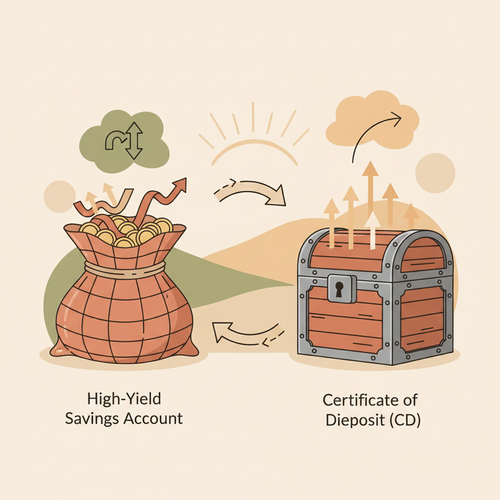
Understanding the differences between High-Yield Savings Accounts vs. CDs is crucial for optimizing your returns. Many beginner investors seek safe places for their money. Fortunately, both options offer security and growth potential. However, their mechanics differ significantly, especially when interest rates fluctuate. Therefore, making an informed decision requires careful consideration of your financial goals and the economic landscape.
Understanding High-Yield Savings Accounts (HYSAs)
High-Yield Savings Accounts (HYSAs) are deposit accounts. They typically offer significantly higher interest rates than traditional savings accounts. Thus, your money grows faster. Often, these accounts are available through online banks. Consequently, they have lower overhead costs, which they pass on to savers.
What are HYSAs?
Specifically, HYSAs function much like regular savings accounts. You deposit money, and it earns interest over time. However, the interest rates on HYSAs are more competitive. For instance, some HYSAs can offer rates several times higher than national averages. Furthermore, your deposits are usually FDIC-insured up to the legal limits. This provides an important layer of security for your funds.
Benefits of HYSAs
- Liquidity: Funds are readily accessible. You can withdraw or transfer money whenever needed. Therefore, HYSAs are excellent for emergency funds.
- Higher Interest Rates: Compared to traditional savings accounts, HYSAs offer superior returns. This means your savings grow more efficiently.
- Flexibility: There are often no fixed terms or penalties for withdrawal. Consequently, you maintain control over your money.
- FDIC Insurance: Your deposits are protected by the FDIC. This offers peace of mind up to $250,000 per depositor, per institution.
Drawbacks of HYSAs
- Variable Interest Rates: HYSA rates can change at any time. If market rates fall, your earnings will decrease. Therefore, returns are not guaranteed to remain high.
- Minimum Balance Requirements: Some HYSAs require a certain minimum balance. Failure to maintain it might result in lower rates or fees.
- Online-Only Experience: Many top HYSAs are offered by online banks. Thus, personal branch services are often unavailable.
Exploring Certificates of Deposit (CDs)
Certificates of Deposit (CDs) represent a different savings vehicle. They offer a fixed interest rate for a specific period. You deposit a sum of money into a CD. In return, the bank guarantees a set interest rate until maturity. Consequently, they provide predictable returns. This makes them attractive for conservative investors.
What are CDs?
A CD is essentially a time deposit. You agree to leave your money untouched for a predetermined term. Terms can range from a few months to several years. In exchange, you receive a fixed interest rate. When the term ends, you get back your principal plus the accrued interest. Therefore, they are considered very low-risk investments. Like HYSAs, CDs are also typically FDIC-insured.
Types of CDs
- Traditional CDs: These are the most common type. They lock in a fixed rate for a fixed term. Breaking the term usually incurs a penalty.
- No-Penalty CDs: Also known as liquid CDs, these allow early withdrawals without penalty. However, they typically offer slightly lower interest rates.
- Step-Up CDs: The interest rate on these CDs increases at predetermined intervals. Consequently, they offer some protection against rising rates.
- Callable CDs: The issuing bank can “call” or redeem these CDs before maturity. If rates fall, the bank might call the CD to reissue at a lower rate.
- Brokered CDs: These are purchased through a brokerage firm. They can offer a wider range of terms and rates. Furthermore, they are often traded on the secondary market.
Benefits of CDs
- Fixed Interest Rates: Your interest rate is locked in for the entire term. This provides certainty about your earnings. Consequently, budgeting becomes easier.
- Predictable Returns: You know exactly how much you will earn. This consistency is valuable for long-term financial planning.
- Low Risk: CDs are considered very safe investments. They are FDIC-insured, protecting your principal.
- Variety of Terms: You can choose terms that align with your financial timeline. This flexibility is a significant advantage.
Drawbacks of CDs
- Limited Liquidity: Your money is locked up until maturity. Early withdrawals often incur penalties. Therefore, CDs are not ideal for emergency funds.
- Interest Rate Risk: If interest rates rise after you open a CD, you miss out on higher earnings. Your fixed rate becomes less competitive.
- Inflation Risk: If inflation outpaces your CD’s interest rate, your purchasing power decreases. Therefore, real returns can be negative.
Interest Rate Fluctuations: Impact on Your Choices
Interest rates constantly shift. Understanding these movements is vital. Your choice between a HYSA and a CD should reflect the current economic climate. Furthermore, anticipating future rate changes can help optimize your returns. Consequently, staying informed about economic news is very important for investors.
Rising Rate Environment
When interest rates are rising, HYSAs become more attractive. Their variable rates adjust upwards. Therefore, your earnings increase over time. Conversely, locking into a long-term CD during rising rates might mean missing out on better future rates. Indeed, you could find your fixed rate quickly becoming sub-optimal. Consequently, shorter-term CDs or a CD laddering strategy might be more prudent.
Falling Rate Environment
In a falling rate environment, CDs gain an advantage. Locking in a higher fixed rate offers protection. Your earnings remain constant, even as other rates decline. Therefore, choosing a longer-term CD can be beneficial. Specifically, HYSAs would see their rates decrease. This would lead to lower earnings for savers. Thus, a CD provides stability during such times.
Stable Rate Environment
During periods of stable interest rates, both options have merits. HYSAs still offer good liquidity with competitive rates. CDs provide guaranteed returns without the worry of rates dropping. The best choice depends on individual liquidity needs. Consequently, personal financial circumstances become the deciding factor. Consider your short-term and long-term goals carefully.
Strategies for Optimizing Returns
Investors can employ various strategies. These strategies maximize earnings in both HYSA and CD vehicles. Furthermore, they help mitigate risks associated with interest rate changes. Consequently, a well-thought-out approach is essential for financial success. Developing a clear plan can significantly boost your overall returns.
CD Laddering
CD laddering is a popular strategy. It involves dividing your investment into multiple CDs with staggered maturity dates. For instance, you might invest in 1-year, 2-year, 3-year, 4-year, and 5-year CDs. As each CD matures, you reinvest the funds into a new long-term CD. This creates regular access to funds. Furthermore, it allows you to take advantage of rising rates. Consequently, you avoid locking all your money into a single rate. This provides a balance between liquidity and higher long-term rates.
Hybrid Approach
Combining HYSAs and CDs can be highly effective. You can use an HYSA for your emergency fund. This ensures easy access to cash. Subsequently, you might allocate additional savings to CDs. Specifically, longer-term CDs can be used for specific financial goals. For instance, a down payment on a house in five years. This approach leverages the strengths of both vehicles. Therefore, it offers both flexibility and guaranteed returns. A diversified approach helps manage different financial needs.
Considering Your Financial Goals
Your personal financial goals should guide your decision. Do you need quick access to your money? An HYSA might be better. Are you saving for a specific goal several years away? A CD could provide predictable growth. Furthermore, your time horizon plays a crucial role. Short-term goals benefit from liquidity. Long-term goals can tolerate less accessibility. Therefore, align your investment choice with your objectives. This ensures your money works best for you.
Key Factors to Consider Before Deciding
Making the right choice involves evaluating several personal factors. Indeed, what works for one investor might not suit another. Therefore, a careful self-assessment is essential. Consider your unique situation thoroughly before committing to either option. Your financial security depends on thoughtful decisions.
Liquidity Needs
How quickly might you need access to your funds? HYSAs offer high liquidity. You can withdraw money without penalty. Conversely, CDs penalize early withdrawals. If you anticipate needing funds unexpectedly, an HYSA is generally superior. Therefore, consider your emergency fund requirements. Ensure you have readily available cash for unforeseen expenses.
Investment Horizon
How long can you comfortably keep your money invested? If you have a short-term goal (under a year), an HYSA or a short-term CD might be suitable. For longer-term goals (1-5 years or more), CDs offer more compelling fixed rates. Specifically, longer CD terms usually come with higher interest rates. Thus, your investment horizon significantly influences the potential returns. Plan accordingly to maximize your earnings.
Risk Tolerance
Both HYSAs and CDs are considered low-risk. They are generally FDIC-insured. However, the ‘risk’ here pertains more to missing out on higher rates (opportunity cost). With HYSAs, the rate can drop. With CDs, you lock in a rate that might become less competitive. Therefore, understand these nuances. Your comfort level with these potential fluctuations should guide your decision. Some investors prefer the certainty of a CD, while others value HYSA flexibility.
Conclusion
Choosing between High-Yield Savings Accounts vs. CDs involves weighing liquidity, interest rate predictability, and your financial goals. Both are excellent tools for beginner investors. Indeed, they provide secure ways to grow your savings. HYSAs offer flexibility and adapt to rising rates. Conversely, CDs provide guaranteed returns and stability in falling rate environments. Therefore, understanding the nuances of each is paramount. Consider your personal liquidity needs and investment horizon. Furthermore, keep an eye on interest rate trends. By making informed decisions, you can effectively optimize your returns and build a stronger financial future. Your proactive planning today truly shapes your wealth tomorrow. For more insights into smart financial planning, explore resources from reputable financial institutions like Investopedia and Forbes. Additionally, stay updated on global economic news through sources such as Reuters, Bloomberg, and The Wall Street Journal. These resources can further enhance your financial literacy and decision-making abilities.