Introduction
Planning for college expenses is a significant financial undertaking for many families. The cost of higher education continues to rise, making early and strategic savings more important than ever. Fortunately, various savings vehicles exist to help parents and guardians prepare for this future expense.
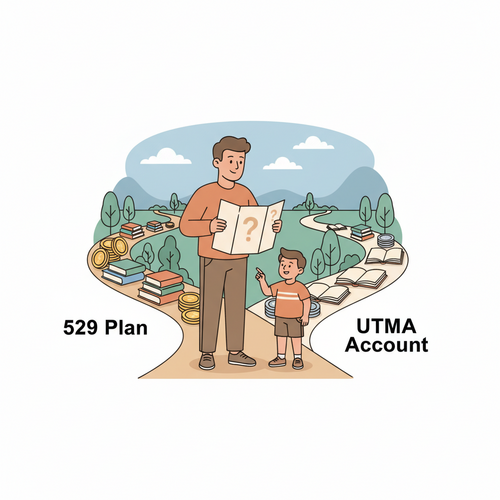
Among the most popular options are the 529 Plan and the Uniform Transfers to Minors Act (UTMA) account. While both allow you to save for a child’s future, they operate under distinct rules and offer different advantages and disadvantages.
Understanding these differences is crucial for making an informed decision that aligns with your financial goals and the specific needs of your family. This article will delve into the intricacies of each option, compare their key features, and help you determine which approach might be best for your college savings strategy.
Understanding the 529 Plan
A 529 Plan is a tax-advantaged savings plan designed specifically to encourage saving for future education costs. It is sponsored by states, state agencies, or educational institutions.
There are generally two types of 529 plans: college savings plans and prepaid tuition plans. College savings plans allow you to invest in mutual funds or similar investments, with earnings growing tax-deferred. Prepaid tuition plans, less common, allow you to purchase future tuition credits at current prices, offering protection against tuition inflation.
Key Benefits of 529 Plans
- Tax Advantages: One of the most significant benefits is the tax treatment. Your investments grow tax-deferred, meaning you don’t pay taxes on earnings each year. When you withdraw funds for qualified education expenses, those withdrawals are completely tax-free at the federal level. Many states also offer state income tax deductions or credits for contributions.
- Ownership and Control: As the account owner, you maintain control over the assets. You decide when and how the money is invested and distributed. This control remains with you even after the beneficiary reaches the age of majority.
- Financial Aid Implications: Generally, 529 plans are considered an asset of the parent (or account owner) for federal financial aid purposes. This typically means they have a less significant impact on financial aid eligibility compared to assets held directly by the student. Only a small percentage of parent assets are counted in the Expected Family Contribution (EFC) calculation.
- Flexibility: You can change the beneficiary of a 529 plan to another eligible family member without tax consequences. This offers great flexibility if the initial beneficiary decides not to attend college or receives a scholarship. Furthermore, 529 plans can be used for a wide range of qualified expenses, including tuition, fees, books, supplies, equipment, room and board (for students enrolled at least half-time), and even certain K-12 tuition expenses up to $10,000 per year per student. More recently, up to $35,000 can be rolled over to a Roth IRA for the beneficiary, subject to specific rules.
Potential Drawbacks of 529 Plans
- Qualified Expense Limitations: While flexible, 529 plans must be used for qualified education expenses. If you use the funds for non-qualified expenses, the earnings portion of the withdrawal will be subject to ordinary income tax and typically a 10% federal penalty tax.
- Investment Options: Your investment choices are often limited to the options offered by your specific state’s plan. While these usually include a range of target-date funds and other portfolios, they might not be as broad as those available in a brokerage account.
- State-Specific Rules: Each state sponsors its own 529 plan, and rules can vary. It’s important to research the plan offered by your state or other states to find the best fit. You are not required to invest in your home state’s plan.
Understanding the UTMA Account
A Uniform Transfers to Minors Act (UTMA) account is a custodial account that allows an adult (the custodian) to manage assets on behalf of a minor. These accounts are also sometimes referred to as Uniform Gifts to Minors Act (UGMA) accounts, which are similar but typically only hold cash and securities, while UTMAs can hold a broader range of assets like real estate.
The key characteristic of a UTMA account is that the assets within it are an irrevocable gift to the minor. The custodian manages these assets until the minor reaches the age of majority in their state, typically between 18 and 21.
Key Benefits of UTMA Accounts
- Flexibility in Use: Unlike a 529 plan, funds in a UTMA account are not restricted to education expenses. They can be used for any purpose that benefits the minor, at the discretion of the custodian, before the minor takes control. This could include summer camps, a car, or even a down payment on a home.
- Simplicity of Setup: UTMA accounts are relatively straightforward to open at most financial institutions. There are fewer administrative hurdles compared to setting up a 529 plan.
- Broad Investment Choices: Custodians typically have a wide array of investment options available, similar to a standard brokerage account. This includes individual stocks, bonds, mutual funds, and exchange-traded funds (ETFs).
- Gift Tax Exclusion: Contributions to a UTMA account are considered completed gifts to the minor. You can contribute up to the annual gift tax exclusion limit (which is $18,000 per donor in 2024) without incurring gift taxes.
Potential Drawbacks of UTMA Accounts
- Irrevocable Gift and Control: Once assets are placed into a UTMA account, they legally belong to the minor. The custodian cannot reclaim the funds. Critically, when the minor reaches the age of majority, they gain full and unrestricted control of the assets. There are no restrictions on how they choose to spend the money, which could include non-educational pursuits.
- “Kiddie Tax” Implications: Earnings within a UTMA account are taxed to the child. While a certain amount of unearned income is often tax-free or taxed at the child’s lower rate, amounts exceeding specific thresholds are subject to the “Kiddie Tax.” This means they are taxed at the parents’ marginal income tax rate, which might be higher. You can find current thresholds and rules from the IRS Publication 929.
- Financial Aid Impact: UTMA accounts are considered assets of the student for financial aid purposes. Student assets are assessed at a much higher rate (typically 20%) in the Expected Family Contribution (EFC) calculation than parent assets (typically 5.64%). This can significantly reduce eligibility for need-based financial aid.
- No Tax-Free Withdrawals for Education: Unlike 529 plans, there is no special tax-free treatment for withdrawals used for education expenses. Earnings will be taxed as they accrue or when assets are sold, subject to capital gains rules.
529 Plan vs. UTMA: A Direct Comparison
When choosing between a 529 plan and a UTMA account for college savings, it’s essential to compare them across several key dimensions. Each feature can have a profound impact on your savings strategy and the future financial well-being of your beneficiary.
Control of Assets
- 529 Plan: The account owner (usually a parent) maintains complete control over the funds. They can change beneficiaries, adjust investments, and decide when distributions occur. The beneficiary never gains legal control of the account.
- UTMA Account: The custodian manages the assets until the minor reaches the age of majority. At that point, the minor receives full legal control over the funds, with no restrictions on how they use the money.
Tax Implications
- 529 Plan: Offers significant tax advantages. Earnings grow tax-deferred and are tax-free when withdrawn for qualified education expenses. Some states also offer tax benefits for contributions.
- UTMA Account: Earnings are generally subject to the “Kiddie Tax.” This means that after a certain threshold, the earnings are taxed at the parents’ higher marginal income tax rate. There are no tax-free withdrawals for education.
Impact on Financial Aid
- 529 Plan: Generally treated as a parent asset (or account owner asset). This has a relatively minor impact on financial aid eligibility, as only a small percentage counts towards the Expected Family Contribution (EFC).
- UTMA Account: Considered a student asset. Student assets are assessed at a much higher rate in the EFC calculation, potentially reducing the student’s eligibility for need-based financial aid.
Spending Flexibility
- 529 Plan: Funds must be used for qualified education expenses to avoid taxes and penalties on earnings. While the definition of “qualified” is broad, it is still education-specific.
- UTMA Account: Funds can be used for any purpose that benefits the minor, at the custodian’s discretion, before the minor gains control. After the age of majority, the funds can be used for absolutely anything the now-adult chooses.
Age of Majority Considerations
- 529 Plan: The account owner retains control indefinitely. The age of the beneficiary does not affect this control.
- UTMA Account: The minor gains full, unrestricted control of the assets at the age of majority (18 or 21, depending on the state). This means they could spend the money on something other than college.
Beneficiary Flexibility
- 529 Plan: You can change the beneficiary to another eligible family member without tax penalties. This is a significant advantage if plans change.
- UTMA Account: The gift is irrevocable to the named minor. You cannot change the beneficiary once the funds are contributed.
Which Option is Right for You?
The choice between a 529 plan and a UTMA account depends heavily on your specific financial situation, your comfort level with relinquishing control, and your primary objectives for the funds. There is no one-size-fits-all answer, and thoughtful consideration is paramount.
When a 529 Plan is Ideal
A 529 plan is typically the preferred choice if your primary goal is to save specifically for education costs and you prioritize tax benefits and control. Consider a 529 if:
- You want to maximize tax advantages, including tax-deferred growth and tax-free withdrawals for qualified education expenses.
- You want to retain control over the assets and ensure they are used for educational purposes.
- You are concerned about the impact on financial aid eligibility and want a savings vehicle that is assessed more favorably.
- You desire the flexibility to change beneficiaries if circumstances evolve.
- You anticipate using the funds for a broad range of higher education expenses, including K-12 tuition, or even apprenticeships. You can learn more about specific rules at the U.S. Securities and Exchange Commission.
When a UTMA Account Might Be Better
A UTMA account might be a better fit if you value ultimate flexibility in how the funds can be used and are comfortable with the minor gaining full control. Consider a UTMA if:
- You want the funds to be available for any purpose benefiting the minor, not just education. This could be a down payment on a house, starting a business, or other significant life events.
- You are comfortable with the child gaining unrestricted control of the assets at the age of majority. You trust them to make responsible financial decisions.
- You desire a broader range of investment options than what a typical 529 plan might offer.
- You have already maximized contributions to other tax-advantaged accounts and are looking for another way to gift money to a minor.
Considering a Hybrid Approach
It’s also possible to use a combination of both a 529 plan and a UTMA account. This hybrid approach can offer a balance of benefits. For example, you could primarily fund a 529 plan for the bulk of college expenses, while using a smaller UTMA account for non-educational needs or as a general savings vehicle that transitions to the child’s control later on.
This strategy allows you to leverage the tax benefits of the 529 for education, while also providing a flexible nest egg for your child’s future, whatever their path may be. Always consider your overall financial plan and consult with a professional.
Seeking Professional Advice
Navigating the complexities of college savings requires careful thought. Consulting with a qualified financial advisor can provide personalized guidance. They can help you assess your current financial situation, understand your risk tolerance, and project future costs. A professional can also help you analyze the specific 529 plans available in your state and other states, as well as the potential tax implications of both account types.
Their expertise can be invaluable in crafting a strategy that optimizes your savings and aligns with your long-term objectives for your child’s education and overall financial future.
Conclusion
Both 529 plans and UTMA accounts serve as valuable tools for saving for a child’s future, but they cater to different needs and priorities. The 529 plan stands out for its specific focus on education, offering significant tax benefits and maintaining parental control over the funds. It is an excellent choice for families whose primary goal is to fund higher education expenses.
Conversely, the UTMA account provides greater flexibility in how the funds can be used, as they are not restricted to educational purposes. However, this flexibility comes with the caveat of the child gaining full control at the age of majority and potential “Kiddie Tax” implications and a greater impact on financial aid. For an overview of financial planning in general, the FINRA website offers comprehensive resources.
Ultimately, the best choice depends on your individual circumstances, your vision for your child’s financial future, and your comfort level with relinquishing control of the assets. By carefully weighing the advantages and disadvantages of each, and perhaps even considering a hybrid approach, you can build a robust college savings strategy that truly supports your educational and financial aspirations.