Introduction
Planning for retirement is one of the most critical financial steps you will ever take. The decisions you make today about where to save can significantly impact your financial well-being decades from now. Among the many options available, the Roth IRA vs. Traditional 401(k) decision stands out as one of the most important for investors.
Both accounts offer significant tax advantages designed to help your savings grow over time. However, their fundamental structures differ, particularly regarding when you pay taxes. Understanding these differences is not merely a matter of financial trivia; it is essential for making an informed choice that aligns with your current income, future tax expectations, and overall financial goals.
This article will explore the intricacies of each account. We will break down how they work, their respective benefits and drawbacks, and ultimately, help you determine which option, or combination, might be the best fit for your unique retirement strategy. Your financial future deserves careful consideration, and selecting the right retirement account is a cornerstone of that planning.
Understanding the Traditional 401(k)
The Traditional 401(k) has long been a cornerstone of retirement planning for many Americans. Often offered through employers, it is a powerful tool for building wealth over the long term, primarily due to its tax-deferred growth.
How a Traditional 401(k) Works
Contributions to a Traditional 401(k) are typically made with pre-tax dollars. This means the money you contribute is deducted from your gross income *before* taxes are calculated. As a result, your taxable income for the current year is reduced, potentially lowering your immediate tax bill.
Your investments within the 401(k) grow on a tax-deferred basis. You do not pay any taxes on capital gains, dividends, or interest as long as the money remains within the account. This allows your investments to compound more aggressively over time.
However, the bill eventually comes due. When you retire and begin to take withdrawals, those distributions are considered taxable income. You will pay ordinary income tax rates on both your contributions and any investment earnings. Many employers also offer a matching contribution to their employees’ 401(k)s. This is essentially “free money” and is a significant incentive to participate. For example, an employer might match 50 cents on the dollar up to 6% of your salary.
Advantages of a Traditional 401(k)
- Immediate Tax Deduction: Contributions reduce your taxable income in the year they are made. This can lead to a lower tax bill now, which is particularly attractive for those in higher tax brackets.
- Potential for Employer Match: Employer matching contributions are a powerful boost to your savings. It is a guaranteed return on your investment, making the 401(k) an almost unbeatable option if an employer match is available.
- Higher Contribution Limits: In 2024, individuals can contribute up to $23,000 to a Traditional 401(k). Those aged 50 and over can make an additional catch-up contribution of $7,500, bringing the total to $30,500. This allows for substantial savings growth.
Disadvantages of a Traditional 401(k)
- Taxable Withdrawals in Retirement: All distributions in retirement are taxed as ordinary income. If your tax bracket is higher in retirement than it was during your working years, you could end up paying more in taxes.
- Required Minimum Distributions (RMDs): At a certain age (currently 73), you *must* begin taking RMDs from your Traditional 401(k), even if you do not need the money. Failing to do so can result in significant penalties.
- Less Flexibility Before Retirement: Generally, withdrawing funds before age 59½ incurs a 10% penalty, in addition to regular income taxes. There are exceptions, but early access is generally punitive.
Unpacking the Roth IRA
The Roth IRA offers a different, yet equally powerful, approach to retirement savings. It flips the tax advantage, making it highly attractive for specific financial situations.
How a Roth IRA Functions
Contributions to a Roth IRA are made with *after-tax* dollars. This means you do not receive an upfront tax deduction for your contributions. You pay income tax on that money in the year you earn it.
However, the significant advantage comes later. Your investments within the Roth IRA grow tax-free. When you meet certain conditions, all qualified withdrawals in retirement are **completely tax-free**. This includes both your contributions and all the earnings your investments have generated.
To qualify for tax-free withdrawals, the account must be open for at least five years, and you must be age 59½ or older. There are also income limitations for contributing directly to a Roth IRA. For 2024, single filers earning above $161,000 and married couples filing jointly above $240,000 face restrictions. You can learn more about these thresholds from official sources like the IRS website.
Advantages of a Roth IRA
- Tax-Free Withdrawals in Retirement: This is the Roth IRA’s biggest draw. All qualified distributions are entirely free from federal income tax. This provides immense certainty for future financial planning.
- No Required Minimum Distributions (RMDs): Unlike Traditional accounts, Roth IRAs do not have RMDs for the original account holder. This offers greater flexibility in managing your wealth in retirement and allows your money to continue growing tax-free for as long as you wish.
- Greater Flexibility with Contributions: You can withdraw your *original contributions* (but not earnings) at any time, tax-free and penalty-free, regardless of your age. This can serve as a backup emergency fund.
Disadvantages of a Roth IRA
- No Immediate Tax Deduction: You do not get a tax break in the present year for your contributions. This can be a significant factor if you are in a high tax bracket now.
- Income Limitations: Your ability to contribute directly to a Roth IRA is limited by your modified adjusted gross income (MAGI). High earners may need to use a “backdoor Roth IRA” strategy.
- Lower Contribution Limits: In 2024, the contribution limit for an IRA (including Roth and Traditional combined) is only $7,000, with an additional $1,000 catch-up contribution for those aged 50 and over. This is significantly lower than a 401(k).
Roth IRA vs. Traditional 401(k): Key Differences
To truly understand which account might suit you best, let us directly compare the critical aspects of the Roth IRA vs. Traditional 401(k).
Tax Treatment
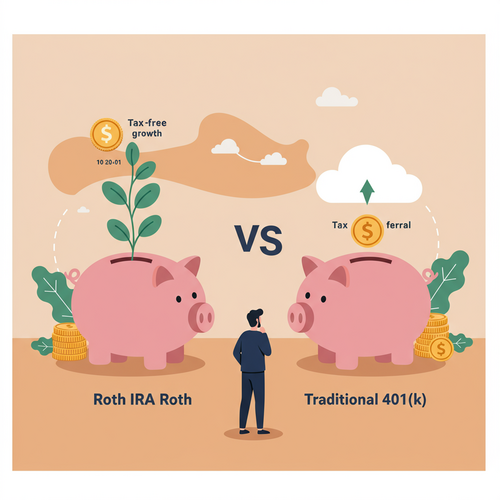
Traditional 401(k): Contributions are generally pre-tax, offering an immediate tax deduction. Growth is tax-deferred. Withdrawals in retirement are taxed as ordinary income. This is often referred to as “tax now, grow later, taxed again at withdrawal.”
Roth IRA: Contributions are after-tax, meaning no immediate tax deduction. Growth is tax-free. Qualified withdrawals in retirement are completely tax-free. This is often called “tax now, grow free, withdraw free.”
The core difference boils down to when you prefer to pay taxes: now (Roth) or in retirement (Traditional). Your expectation of future tax rates is a primary driver here.
Contribution Limits
Traditional 401(k): Offers higher contribution limits ($23,000 in 2024).
Roth IRA: Has lower contribution limits ($7,000 in 2024).
The higher limits of the 401(k) make it a powerful tool for high-income earners who want to defer a large portion of their income.
Employer Matching
Traditional 401(k): Often comes with an employer matching contribution. This is a significant benefit and can accelerate your retirement savings substantially.
Roth IRA: As an individual retirement account, it does not receive direct employer contributions.
Which Account is Best for You?
The “best” choice in the Roth IRA vs. Traditional 401(k) debate is rarely universal. It hinges entirely on your personal financial circumstances, tax bracket, and long-term outlook.
Consider Your Current Income and Tax Bracket
If you are currently in a high tax bracket, the immediate tax deduction offered by a Traditional 401(k) can be very appealing. It lowers your taxable income now, giving you tax savings today. Conversely, if you are in a lower tax bracket now (perhaps early in your career), a Roth IRA might be more beneficial. Paying taxes on your contributions at a lower rate today means you avoid paying potentially higher taxes on all your earnings in retirement.
Anticipated Future Tax Rate
This is arguably the most crucial factor. Do you expect your tax rate to be higher or lower in retirement than it is today?
- Expect Higher Future Tax Rates: If you believe you will be earning more, or tax rates will generally increase in the future, the Roth IRA is likely your best bet.
- Expect Lower Future Tax Rates: If you anticipate a significantly lower income in retirement, the Traditional 401(k) could be more advantageous.
Combining Strategies (Hybrid Approach)
For many individuals, the optimal strategy involves a combination of both account types. This “hybrid approach” allows you to diversify your tax exposure in retirement. You can benefit from the upfront tax deduction of a Traditional 401(k) while also building a pot of tax-free money with a Roth IRA.
A common strategy is to contribute enough to your 401(k) to get the full employer match, then max out a Roth IRA (if eligible), and finally, if you have more to save, contribute extra to your 401(k).
Conclusion
Choosing between a Roth IRA vs. Traditional 401(k) is a fundamental decision in your retirement planning journey. There is no single “best” answer that applies to everyone. Instead, the ideal choice depends on a careful evaluation of your current income, your expected tax bracket in retirement, whether you have access to an employer match, and your need for flexibility.
The Traditional 401(k) shines for those who benefit from an immediate tax deduction and expect to be in a lower tax bracket during retirement. Its higher contribution limits and potential for employer matching are significant advantages. The Roth IRA, on the other hand, is a powerful tool for individuals who anticipate higher tax rates in the future or desire tax-free withdrawals. Many savvy investors find that a diversified approach, utilizing both account types, provides the most robust strategy. We recommend consulting with a qualified financial advisor like those found via CFP Board to help you assess your unique situation.