Introduction
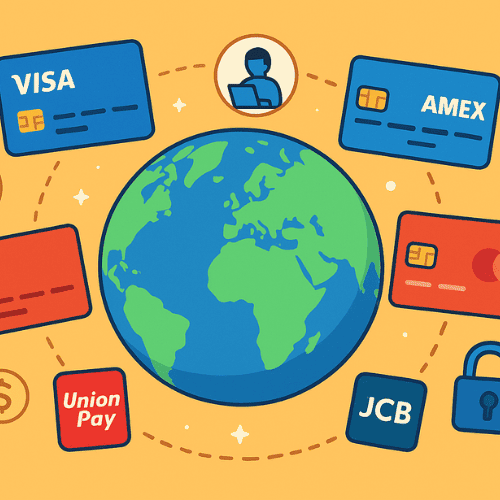
Credit cards are more than just pieces of plastic—they are access points to a global financial network that enables billions of transactions every day. When you swipe, tap, or enter your card number online, you’re not just connecting with your bank; you’re interacting with one of the powerful credit card networks that dominate the global financial system.
For freelancers, digital entrepreneurs, and anyone earning money online, understanding these networks is more than trivia. It’s about knowing which cards are accepted internationally, how transaction fees vary, and how networks like Visa or Mastercard can impact cross-border payments. In fact, credit card networks have become one of the cornerstones of the modern digital economy, bridging the gap between consumers, banks, and merchants across the world.
In this article, we’ll dive deep into the major credit card networks globally, examine their roles in online finance, explore emerging players in the digital payments space, and highlight how they impact everyday users and online earners alike.
What Is a Credit Card Network?
A credit card network (also called a card scheme) is the infrastructure that enables payments to happen between a consumer, their bank (issuer), and the merchant’s bank (acquirer). These networks set rules for transactions, ensure security, and process billions of authorizations daily.
Here’s how it works in a simplified flow:
-
You make a purchase with your credit card.
-
The transaction request goes through the card network (e.g., Visa).
-
The network communicates with your bank to approve or decline.
-
Funds are transferred from your bank to the merchant’s bank, less fees.
The power of these networks lies in their acceptance. A global traveler, a digital freelancer, or an online store owner benefits from knowing that the card in their pocket will work nearly everywhere.
The Big Four Global Credit Card Networks
1. Visa
-
Overview: Visa is the largest credit card network in the world, accepted in over 200 countries.
-
Strengths: Its global acceptance, cutting-edge fraud protection, and strong partnerships with banks make it the top choice for international payments.
-
Relevance for online earners: Freelancers using platforms like Upwork or Fiverr often receive payments routed through Visa-backed debit or prepaid cards, making it a staple in cross-border finance.
2. Mastercard
-
Overview: Mastercard rivals Visa in global reach, with cards accepted in over 210 countries.
-
Strengths: Known for innovations in digital payments, such as contactless and tokenization, Mastercard plays a key role in e-commerce security.
-
Relevance for freelancers: Mastercard’s partnerships with fintech platforms and digital wallets mean it’s often behind many prepaid solutions for online workers.
3. American Express (Amex)
-
Overview: Amex operates as both a card issuer and a network, which gives it more control but limits global acceptance compared to Visa or Mastercard.
-
Strengths: Premium benefits, strong customer service, and reward programs make it popular among high-spending consumers and business travelers.
-
Limitations: Merchants sometimes reject Amex due to higher fees. For freelancers, this may mean fewer clients willing to pay with Amex.
4. Discover
-
Overview: Discover is widely used in the United States but has limited acceptance abroad.
-
Strengths: Competitive rewards and no annual fees on many cards make it attractive domestically.
-
Limitations: Lower international presence compared to Visa and Mastercard, which may be a drawback for freelancers dealing with global clients.
Regional and Emerging Credit Card Networks
While the Big Four dominate globally, many regions have developed their own networks for political, economic, or security reasons.
UnionPay (China)
-
The largest card network by number of issued cards, UnionPay dominates China’s domestic market.
-
Increasingly expanding into Asia, Africa, and Europe.
-
Many online platforms in China only support UnionPay, making it essential for freelancers dealing with Chinese clients.
JCB (Japan Credit Bureau)
-
Based in Japan, JCB is accepted across Asia and gaining traction globally.
-
Strong partnerships with banks in emerging markets make it relevant for cross-border payments within Asia-Pacific.
RuPay (India)
-
India’s domestic card network, promoted by the government for financial inclusion.
-
Gaining traction within India but with limited acceptance abroad.
-
Important for freelancers with Indian clients, as many digital wallets and banks integrate RuPay.
How Credit Card Networks Make Money
Credit card networks charge interchange fees and network fees. Merchants pay these fees for each transaction, which is why some stores prefer one network over another.
For freelancers or small online businesses, this cost translates into processing fees charged by platforms like PayPal, Stripe, or Wise. Networks with higher fees (like Amex) may result in higher charges for clients and lower net income for freelancers.
The Role of Credit Card Networks in Digital Payments
With the rise of digital wallets (like Apple Pay, Google Wallet, and PayPal), credit card networks are evolving rather than disappearing. Most wallets still rely on Visa, Mastercard, or Amex infrastructure to complete transactions.
Moreover, contactless payments and tokenized security measures are setting new standards for online payments. For freelancers, this means faster, safer, and more reliable ways to receive global payments.
Credit Card Networks vs. Cryptocurrencies
A fascinating trend is the competition between card networks and cryptocurrencies. While Visa and Mastercard process trillions annually, crypto networks like Bitcoin or Ethereum are emerging as decentralized alternatives.
Instead of competing outright, however, many card networks are integrating crypto. For example, Visa and Mastercard already issue co-branded crypto debit cards that let freelancers convert digital assets into fiat seamlessly.
This hybrid system might define the future: traditional networks for trust and scale, crypto networks for speed and independence.
What Freelancers Should Consider
When choosing which card to use for online work or global payments, freelancers should consider:
-
Acceptance: Visa and Mastercard remain the safest bet for global clients.
-
Fees: Platforms that use Amex may pass higher costs to clients.
-
Rewards and Perks: Cashback or points can offset expenses for freelancers.
-
Regional Needs: If working with clients in Asia, JCB or UnionPay may be essential.
-
Future-proofing: Stay updated on crypto integration with card networks.
Conclusion
Credit card networks are the invisible backbone of global commerce. From Visa and Mastercard’s massive international acceptance to regional players like UnionPay or RuPay, these systems shape how money flows across borders. For freelancers and digital entrepreneurs, understanding the differences between networks isn’t just academic—it’s practical knowledge that impacts fees, payment speed, and client relationships.
As finance becomes increasingly digital, credit card networks will remain central to both traditional and online economies. They’re adapting quickly, integrating with digital wallets and even cryptocurrencies, ensuring they remain essential to the global financial ecosystem.
The next time you swipe, tap, or click “pay,” remember: behind that transaction lies a powerful global network connecting you to the wider world.