Executive Summary
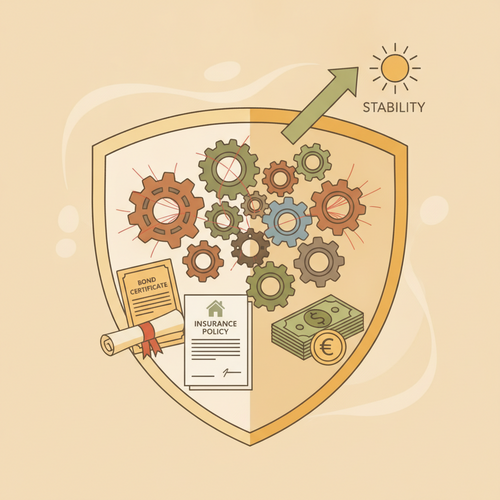
- Systemic risk necessitates sophisticated transfer mechanisms beyond traditional insurance.
- Innovative solutions, including insurance-linked securities, redefine corporate premium engineering.
- Strategic integration of data analytics and regulatory foresight optimizes risk management frameworks.
Deconstructing Systemic Risk: A Foundational Perspective
Systemic risk poses an existential threat to financial stability. It describes the risk of cascading failures within an interconnected system. Such failures can cripple an entire market or economy.
Interdependencies amplify initial shocks. Contagion pathways transmit distress rapidly across institutions. This necessitates a robust framework for macroprudential oversight.
Traditional microprudential regulation often falls short. It primarily focuses on individual firm solvency. Systemic risk demands a broader, holistic perspective.
Expert Insight: “Understanding endogenous vulnerabilities is paramount. Exogenous shocks often expose pre-existing fragilities within the financial architecture, triggering widespread distress.”
Identifying key nodes within the financial network is critical. Their failure could precipitate broader collapse. Stress testing these interconnections provides valuable foresight.
Traditional Risk Transfer Paradigms: Limitations and Evolution
Traditional insurance and reinsurance serve as primary risk transfer tools. They enable corporations to offload specific perils. This protects balance sheets from unexpected losses.
Reinsurance contracts redistribute risk among insurers. Retrocession further diversifies exposure. These mechanisms enhance underwriting capacity globally.
Captive insurance companies offer bespoke solutions. They provide self-insurance benefits. They also optimize tax and regulatory advantages for their parent organizations.
- Reinsurance: Transfers portions of risk from one insurer to another.
- Retrocession: A reinsurer transfers part of its assumed risk to another reinsurer.
- Captive Insurance: A subsidiary created to insure the risks of its parent company.
However, traditional structures face limitations. Extreme loss events can exhaust conventional capacity. Aggregation of correlated risks remains a persistent challenge.
The Nexus of Capital Markets and Risk Transfer: Insurance-Linked Securities (ILS)
Insurance-Linked Securities (ILS) represent a critical innovation. They bridge the gap between insurance and capital markets. ILS facilitate the transfer of catastrophic risks to investors.
Catastrophe bonds (Cat Bonds) are a prominent ILS instrument. Investors receive coupon payments. They assume the risk of principal loss if a predefined catastrophic event occurs.
This securitization diversifies risk away from traditional insurers. It provides alternative capital to cover extreme perils. Investors gain exposure to uncorrelated returns.
Collateralized Reinsurance offers another ILS avenue. It involves fully collateralized reinsurance contracts. These are typically held in trust for the benefit of the cedent.
ILS structures typically utilize Special Purpose Vehicles (SPVs). These vehicles issue the securities. They hold the collateralized funds, ensuring claims payment.
Market Warning: “Basis risk in ILS products must be meticulously managed. Misalignment between insured losses and trigger events can lead to unexpected financial shortfalls for the protection buyer.”
Learn more about Systemic Risk: https://www.investopedia.com/terms/s/systemicrisk.asp
Advanced Corporate Insurance Premium Engineering: Beyond Actuarial Tables
Premium engineering has evolved significantly. It now integrates sophisticated data analytics and predictive modeling. This moves beyond traditional actuarial methodologies.
Big data and machine learning algorithms refine risk assessment. They identify subtle patterns in loss experience. This allows for highly granular pricing decisions.
Behavioral economics plays a growing role. Insurers incentivize risk mitigation behaviors. This reduces the frequency and severity of claims over time.
Customized parametric insurance solutions are gaining traction. These policies pay out based on predefined external triggers. They are not reliant on actual loss assessment.
The Role of Telematics and IoT in Dynamic Pricing
Telematics devices provide real-time data. They monitor asset performance and operational conditions. This enables dynamic premium adjustments.
Internet of Things (IoT) sensors enhance risk monitoring. They detect potential hazards early. This facilitates proactive intervention and loss prevention.
For instance, fleet insurance premiums can adjust based on driver behavior. Smart factory policies can respond to machinery maintenance data. This creates a feedback loop for risk reduction.
Parametric Triggers and Basis Risk Management in Modern Policies
Parametric insurance offers expedited claims settlement. It relies on independent, objective data points. These trigger immediate payouts upon event occurrence.
Examples include hurricane policies based on wind speed. Earthquake policies might use Richter scale magnitude. Agricultural insurance can use rainfall indices.
Managing basis risk is paramount in parametric design. Basis risk arises when the trigger event does not perfectly align with actual losses. It creates a gap in protection.
Robust data validation is crucial. High-quality, verifiable public data sources minimize discrepancies. Satellite imagery and government weather stations are common data providers.
Applications Across Diverse Sectors
Parametric solutions are revolutionizing several industries. They provide swift liquidity post-disaster. This supports business continuity and recovery.
In the energy sector, policies can trigger based on temperature anomalies. This protects against revenue loss from reduced demand. Supply chain disruptions can activate specific triggers.
Consider non-damage business interruption insurance. A parametric trigger for a port closure, irrespective of physical damage, could provide immediate relief. This enhances resilience.
Regulatory Arbitrage and Global Risk Cascades: A Policy Imperative
The globalized nature of finance creates regulatory complexities. Firms may exploit jurisdictional differences. This can lead to regulatory arbitrage.
Divergent capital requirements or solvency regimes create incentives. Entities might shift risk or operations to less stringent environments. This can undermine systemic stability.
International frameworks aim for harmonization. Basel III addresses banking capital and liquidity. Solvency II regulates European insurers.
However, perfect alignment remains elusive. Cross-border risk transfer mechanisms require coordinated oversight. This prevents the accumulation of hidden liabilities.
Expert Insight: “Effective global supervision is not merely about convergence. It’s about intelligent coordination to identify and mitigate cross-jurisdictional systemic vulnerabilities before they propagate.”
Understand more about Catastrophe Bonds: https://www.investopedia.com/terms/c/catastrophebond.asp
The Financial Stability Board (FSB) plays a key role. It monitors and recommends policies. This addresses systemic vulnerabilities in the global financial system.
Emerging Frontiers: Cyber Risk and Climate Change Adaptations
Cyber risk presents a novel systemic challenge. Its intangible nature complicates quantification. The potential for widespread, simultaneous attacks is significant.
Cyber insurance markets are rapidly evolving. Policies cover data breaches, business interruption, and ransomware attacks. Tailoring these policies requires advanced threat intelligence.
Climate change poses long-duration systemic risks. Physical perils, like extreme weather, increase in frequency and intensity. Transition risks arise from decarbonization efforts.
Financing climate resilience demands innovative mechanisms. Public-private partnerships are crucial. They mobilize capital for adaptation and mitigation projects.
Innovation in Long-Term Risk Financing
Catastrophe pools and sovereign risk funds provide collective protection. They aggregate resources to withstand large-scale events. These are often supported by government backing.
Green bonds and sustainability-linked bonds offer capital. This capital supports environmentally friendly projects. It integrates climate risk into investment decisions.
The evolving landscape necessitates continuous innovation. Risk transfer mechanisms must adapt. They need to address novel systemic threats effectively.
Conclusion
Navigating systemic risk requires multifaceted approaches. Traditional insurance mechanisms are insufficient alone. Capital markets solutions and advanced premium engineering are imperative.
Leveraging data analytics drives granular risk assessment. Parametric insurance offers agile protection. Proactive regulatory coordination mitigates cross-border vulnerabilities.
The integration of technology and strategic foresight defines modern risk management. Firms must embrace dynamic solutions. This builds enduring resilience against unforeseen shocks.
How will your organization adapt its risk transfer strategy to these evolving systemic challenges?