Introduction
Have you ever looked at a credit card statement, a mortgage offer, or a savings account advertisement and seen a percentage followed by the words “interest rate”? It’s a term we encounter constantly in our financial lives, yet many of us nod along without fully grasping its profound impact. What exactly is this percentage? Is it a penalty, a reward, or something else entirely? If you’ve ever felt a bit lost in the financial jargon, you’re not alone. Understanding interest rates is one of the most fundamental skills in personal finance, acting as a key that unlocks a deeper comprehension of everything from debt to investments.
This guide is designed for beginners and intermediate learners who want to pull back the curtain on this crucial topic. We will demystify what interest rates are, explore how they work for you (and against you), and break down the essential terminology you need to know. Gaining this knowledge empowers you to make more informed decisions, whether you’re choosing a bank account, taking out a loan, or planning for your future. Think of it as learning the language of money—a language that can help you navigate your financial journey with greater confidence and clarity.
What Exactly Is an Interest Rate?
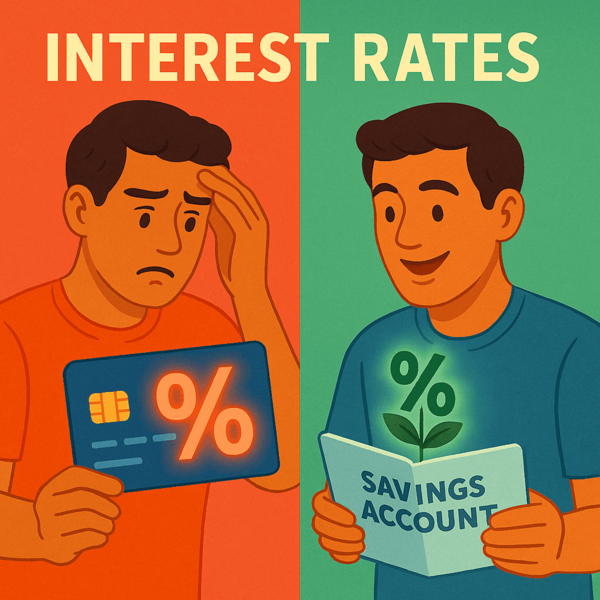
At its core, an interest rate is the cost of borrowing money, expressed as a percentage of the total loan amount. Think of it like a rental fee. When you borrow money from a lender (like a bank), you are essentially “renting” their funds. The interest is the fee you pay for the privilege of using that money over a period of time.
Conversely, when you deposit money into a savings account, the roles are reversed. You are lending your money to the bank. In this scenario, the bank pays you interest as a reward for letting them use your funds (which they typically lend out to other customers).
So, an interest rate is a two-way street:
- When you are the borrower (e.g., loans, credit cards): It’s the price you pay. A lower interest rate is better for you.
- When you are the lender/saver (e.g., savings accounts, bonds): It’s the reward you earn. A higher interest rate is better for you.
Understanding this dual nature is the first step toward making interest rates work in your favor. It’s a fundamental concept in personal finance that influences every major financial decision.
The Two Sides of the Financial Coin: Earning vs. Paying Interest
Interest is not a single, monolithic concept; it manifests differently depending on the financial product. Recognizing whether you are on the paying or earning side is crucial for effective financial management.
Earning Interest: Making Your Money Work for You
Earning interest is the passive, wealth-building side of the equation. This happens when you place your money in certain financial accounts or products where an institution pays you for its use.
- Savings Accounts: These are the most common interest-bearing accounts offered by banks. While the rates can be modest, they allow your money to grow safely.
- Certificates of Deposit (CDs): A CD is a type of savings account that holds a fixed amount of money for a fixed period of time (e.g., six months, one year, five years), typically at a higher interest rate than a standard savings account. The trade-off is less liquidity, as you agree not to withdraw the funds until the term ends.
- Bonds: When you buy a bond, you are lending money to a government or a corporation. In return, they promise to pay you periodic interest payments (called “coupon payments”) and return the principal amount at the end of the bond’s term.
Paying Interest: The Cost of Borrowing
This is the side of interest that requires careful management, as it represents a cost. Paying interest is a core component of most forms of debt.
- Loans (Auto, Mortgage, Personal): When you take out a loan, the interest rate determines the total amount you will pay back over the life of the loan. Even a small difference in the rate can translate to thousands of dollars over several years.
- Credit Cards: Credit cards often come with high interest rates. If you carry a balance from one month to the next, the interest charged can quickly accumulate, making it difficult to pay off the debt. This is why understanding your card’s Annual Percentage Rate (APR) is so important.
Simple vs. Compound Interest: The Unseen Force
Not all interest is calculated in the same way. The distinction between simple and compound interest is one of the most powerful concepts in finance.
Simple Interest is calculated only on the original principal amount.
- Formula:
Simple Interest = Principal × Rate × Time - Example: If you save $1,000 in an account with a 5% simple annual interest rate, you will earn $50 every year ($1,000 x 0.05). After three years, you’d have earned $150 in total interest.
Compound Interest, on the other hand, is “interest on interest.” It’s calculated on the initial principal and on the accumulated interest from previous periods.
Let’s imagine a scenario. Meet Alex, who just opened a savings account with $1,000 that offers a 5% annual interest rate, compounded annually.
- Year 1: Alex earns $50 in interest ($1,000 x 0.05). The new balance is $1,050.
- Year 2: The interest is now calculated on $1,050. Alex earns $52.50 ($1,050 x 0.05). The new balance is $1,102.50.
- Year 3: The interest is calculated on $1,102.50. Alex earns $55.13. The new balance is $1,157.63.
After three years, Alex has earned $157.63 in interest, which is $7.63 more than with simple interest. While it seems small at first, this effect snowballs dramatically over time, making compound interest an incredibly powerful engine for wealth growth. The same principle, however, works against you with debt, which is why paying down high-interest loans is so critical.
Key Terms Unpacked: APR vs. APY
When looking at financial products, you’ll often see two related but distinct terms: APR and APY.
- APR (Annual Percentage Rate): This is associated with borrowing. APR represents the annual cost of a loan, including the interest rate and certain fees (like origination fees). It gives you a more holistic view of the cost of debt but usually doesn’t account for the effects of intra-year compounding on your loan balance. For an in-depth look, a great resource is the Consumer Financial Protection Bureau’s explanation on APR.
- APY (Annual Percentage Yield): This is associated with saving and investing. APY represents the total amount of interest you will earn on a deposit over a year, and it does include the effect of compounding. Because of this, the APY is often slightly higher than the stated “interest rate,” giving you a more accurate picture of your earnings.
Practical Insight: When comparing loans, look for the lowest APR. When comparing savings accounts or CDs, look for the highest APY.
What Factors Influence Interest Rates?
Interest rates aren’t pulled out of thin air. They are influenced by a complex mix of economic factors and personal details.
- Central Bank Policies: National central banks (like the Federal Reserve in the U.S.) set a baseline interest rate that influences the rates commercial banks offer to their customers.
- Inflation: When inflation is high (meaning the cost of living is rising), lenders demand higher interest rates to ensure they make a real return on their money.
- Economic Growth: In a strong economy, demand for loans is high, which can push rates up. In a weaker economy, rates may be lowered to encourage borrowing and spending.
- Your Credit Score: This is a huge personal factor. A higher credit score signals to lenders that you are a low-risk borrower, making you eligible for lower interest rates.
- Loan Type and Term: A long-term loan like a 30-year mortgage often has a different rate than a short-term 5-year auto loan. Secured loans (backed by collateral, like a house) typically have lower rates than unsecured loans (like personal loans). Reputable sites like Bankrate provide current market rates for various products.
Conclusion
Interest rates are more than just numbers on a page; they are the invisible currents that shape our financial lives. They determine the cost of our ambitions, like buying a home or car, and fuel the growth of our savings over time. By understanding the fundamental difference between paying and earning interest, grasping the power of compounding, and learning to decipher terms like APR and APY, you move from being a passive participant to an active and informed manager of your own finances.
This knowledge doesn’t require you to become a financial expert overnight. It’s about building a solid foundation, one concept at a time. The next time you encounter an interest rate, you’ll be equipped with the context to understand what it truly means for your wallet. Continue exploring these topics, ask questions, and seek out information that empowers you. What are your thoughts or questions about interest rates? Share them in the comments below!