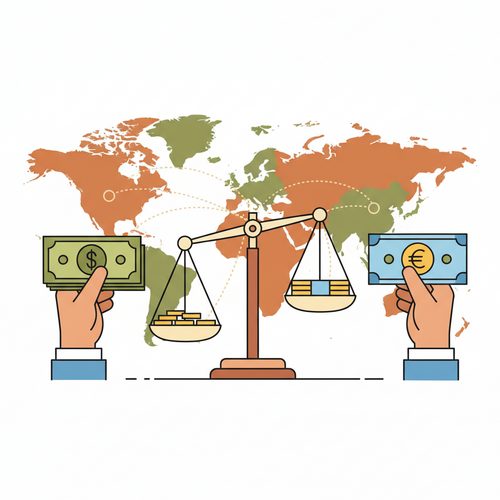
Navigating international payments often presents a critical dilemma: should you pay in local currency vs USD? This choice significantly impacts your wallet. Consequently, understanding exchange rates is paramount for anyone spending money abroad or conducting international transactions. Many beginner investors, furthermore, overlook the nuances of currency conversion, potentially losing money unnecessarily.
Indeed, the world of foreign exchange can seem complex. However, with a clear understanding, you can make informed decisions. We will uncover the truth behind exchange rates, providing actionable advice. Therefore, you can confidently manage your money when traveling or investing internationally.
Understanding Exchange Rates: The Foundation
What exactly are exchange rates? Simply put, an exchange rate tells you how much one currency is worth in terms of another. For instance, if 1 USD equals 0.92 Euros, you know the conversion value. Banks and financial institutions constantly update these rates. Therefore, they reflect global economic conditions and market demand.
How Exchange Rates Work
Exchange rates operate on a supply and demand principle. Numerous factors influence their daily fluctuations. For example, a country’s economic stability greatly affects its currency’s value. Strong economies typically have stronger currencies. Conversely, political instability often weakens a currency.
Interest rates also play a significant role. Higher interest rates can attract foreign investment. Consequently, this increases demand for the local currency. Inflation is another key factor. High inflation erodes a currency’s purchasing power. Thus, its value relative to other currencies decreases.
Banks often display two main rates: a “bid” rate and an “ask” rate. The bid rate is what they will pay for a currency. Conversely, the ask rate is what they will sell it for. The difference between these two is called the “spread.” This spread represents the bank’s profit margin. Therefore, understanding this spread helps you identify fair rates.
The “mid-market rate” is a theoretical average between the bid and ask prices. This rate represents the true value of a currency. Major financial news outlets, such as Reuters, often report mid-market rates. Always compare any offered exchange rate against this benchmark. You will thus ensure you are getting a reasonable deal.
The Dynamic Currency Conversion (DCC) Trap
One of the most common pitfalls for international travelers is Dynamic Currency Conversion, or DCC. This service allows you to pay in your home currency, like USD, even when you are abroad. While it sounds convenient, DCC often comes at a high cost. Merchants offering DCC typically use unfavorable exchange rates. Furthermore, they add their own fees on top.
When you choose DCC, the merchant’s bank, not your own, handles the conversion. This institution sets the exchange rate. In many cases, this rate is significantly worse than what your credit card company or bank would offer. You might pay an extra 3-7% on your purchase. Therefore, always decline DCC when presented with the option.
How to Avoid DCC
Avoiding DCC is straightforward. When a merchant or ATM asks if you want to pay in USD or the local currency, always choose the local currency. For instance, if you are in Europe, select Euros. In Mexico, choose Pesos. This simple action ensures your own bank or card provider handles the conversion. Consequently, you typically receive a much better rate. Always be vigilant at points of sale, especially when using card readers. The choice prompt often appears suddenly.
When to Choose Local Currency: The Golden Rule
The general truth about exchange rates is clear: almost always choose to pay in the local currency. This rule applies to credit card transactions, ATM withdrawals, and even cash payments. Your bank or credit card company generally offers more competitive exchange rates. They process a high volume of foreign transactions. Therefore, they can secure better wholesale rates.
Furthermore, choosing the local currency provides greater transparency. Your card statement will clearly show the transaction in the local currency. It also shows the converted USD amount. This allows you to verify the exchange rate used. Conversely, with DCC, the rate is often opaque and difficult to challenge.
Advantages of Local Currency Payments
- Better Exchange Rates: Your financial institution typically provides superior rates.
- Transparency: Easily track the exact rate applied to your transaction.
- Reduced Fees: Avoid the hidden surcharges often associated with DCC.
- Control: Maintain control over your financial transactions abroad.
Rare Exceptions and Cautions for USD Use
While the golden rule is to use local currency, very few exceptions exist. In some highly tourist-dependent areas, small vendors might accept USD directly. However, these instances are rare and usually come with a poor exchange rate. They factor in their own conversion costs and convenience fees. Therefore, you are still likely losing money compared to using local currency.
Certain situations, like paying for specific international tours or accommodations pre-booked online, might quote prices in USD. In these cases, the USD is the initial quoted currency. Therefore, paying in USD might be unavoidable. Always check the terms and conditions carefully. Understand any potential conversion fees charged by the booking platform. Bloomberg, for instance, often covers global payment trends that highlight these nuances on their website Bloomberg.
Conversely, completely avoid unofficial money exchangers or “black markets.” These operations are illegal and highly risky. You could receive counterfeit currency. You could also face exorbitant fees or even become a victim of crime. Always use official banking channels or reputable exchange services.
Smart Strategies for International Payments
Mastering international payments involves more than just selecting the right currency. Several strategies can further optimize your spending abroad. Implement these tips to safeguard your finances. You will thus enhance your travel experience and protect your investments.
Utilize Credit Cards Wisely
Many credit cards now offer no foreign transaction fees. This feature saves you 1-3% on every international purchase. Before traveling, check with your credit card issuer. Understand their policies regarding foreign transactions. Furthermore, always use a credit card for larger purchases. This offers better fraud protection than debit cards or cash. Financial experts at Investopedia frequently advise on these benefits.
ATM Withdrawals: Your Best Cash Option
When you need cash, withdrawing local currency from an ATM linked to a major bank is generally the best option. These ATMs usually provide exchange rates very close to the interbank rate. Avoid standalone ATMs in convenience stores or tourist traps. These often charge higher fees. Additionally, always decline DCC at the ATM. Choose to be charged in the local currency.
Inform Your Bank of Travel Plans
Before any international trip, notify your bank and credit card companies of your travel dates and destinations. This prevents your cards from being flagged for suspicious activity. Consequently, you avoid the inconvenience of frozen accounts. A quick phone call or online notification can save you significant hassle. This proactive step is crucial for smooth financial operations abroad.
Monitor Exchange Rates
Stay informed about exchange rate movements. While you cannot time every transaction perfectly, understanding trends helps. For instance, if you anticipate a need for a large amount of foreign currency, consider exchanging money when the rate is favorable. Many financial apps provide real-time currency converters. The Federal Reserve offers data that can inform these trends.
Avoid Airport Exchange Booths
Airport currency exchange booths are notoriously expensive. They often have wide spreads and high commission fees. Their convenience comes at a premium. Consequently, you receive a much poorer exchange rate compared to banks or ATMs. Plan ahead and obtain a small amount of local currency before you travel, if necessary, or withdraw from an ATM upon arrival. The Wall Street Journal, for example, often publishes articles on travel money tips available on their homepage Wall Street Journal.
Exchange Rates and Beginner Investors
Understanding exchange rates extends beyond travel. For beginner investors, currency fluctuations can impact international investments. If you invest in foreign stocks or bonds, changes in the exchange rate affect your returns. For instance, if the USD strengthens against a foreign currency, your foreign investment might be worth less when converted back to USD. Therefore, currency risk is an important consideration.
Diversification across different currencies and regions can mitigate this risk. Investors might consider currency-hedged ETFs. These funds aim to neutralize the impact of currency movements. However, this is a more advanced strategy. For beginners, awareness of currency risk is the first step. Consider how geopolitical events might influence currency markets. Therefore, staying informed is key.
Conclusion
In conclusion, the decision to pay in local currency vs USD is usually straightforward. Always opt for the local currency when making purchases or withdrawals abroad. This simple rule helps you avoid unfavorable exchange rates and hidden fees associated with Dynamic Currency Conversion. Your own bank or credit card provider typically offers the most advantageous conversion rates. Furthermore, adopting smart financial habits like using no-foreign-transaction-fee cards and informing your bank of travel plans will significantly enhance your international spending experience. By understanding these truths about exchange rates, you empower yourself to save money and make more confident financial decisions, whether you’re traveling or investing globally.